How Does a HELOC Work? Draw Period & Repayment Explained
If you understand how a credit card works, you are about 60% of the way to understanding a HELOC. The remaining 40% is what makes a HELOC genuinely different — and that 40% is almost entirely about time. A credit card has no draw period, no repayment period, no phase transition. A HELOC has all three, and the way those phases unfold is the single most important thing to understand before you sign for one.
This article walks through the entire lifecycle of a HELOC — from the day you’re approved through the day it’s paid off — with real numbers at every stage so you can see exactly what happens and when.
The Three Phases of a HELOC
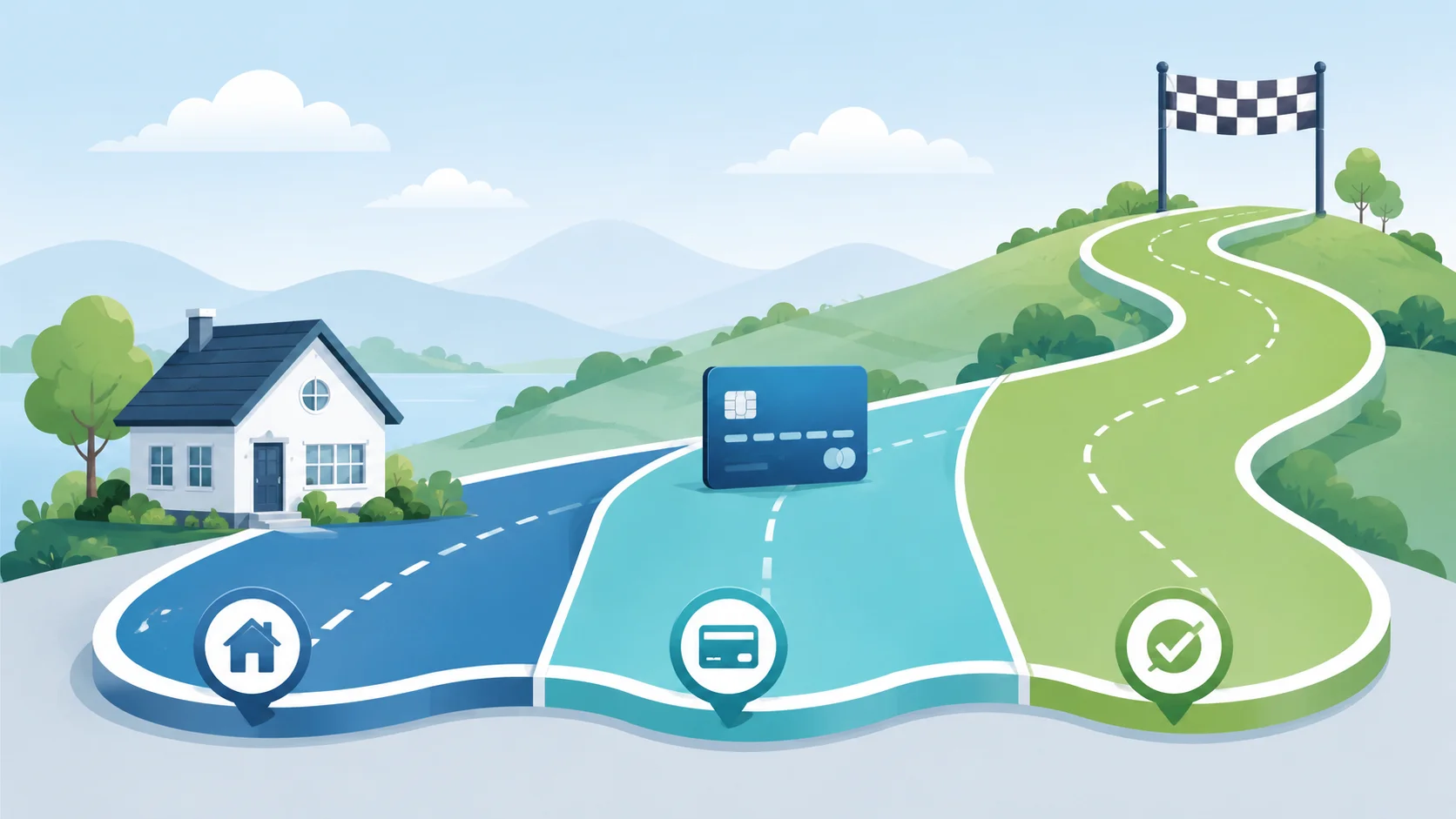
Every HELOC moves through three distinct phases:
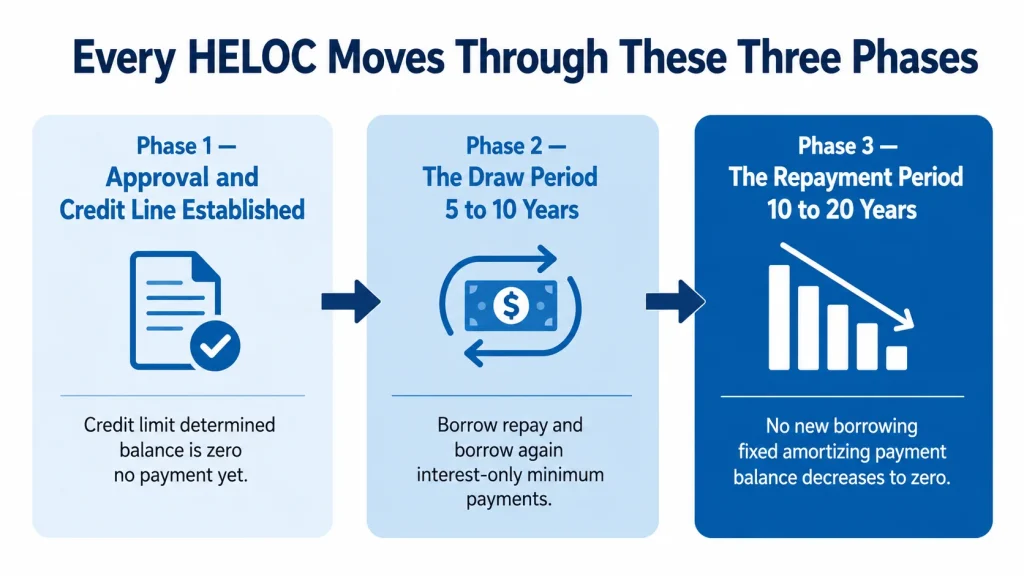
Phase 1: Approval and credit line establishment. The lender determines your credit limit based on your home’s equity, and the HELOC is opened — but you have not borrowed anything yet.
Phase 2: The draw period. You can borrow against the credit line as needed, typically for 5 to 10 years. Minimum payments during this phase are usually interest-only.
Phase 3: The repayment period. The draw period ends, no further borrowing is allowed, and your outstanding balance is repaid through fixed monthly payments over 10 to 20 years.
Understanding these three phases — and especially the transition between phases 2 and 3 — is the foundation for using a HELOC well.
Phase 1: How Your Credit Line Gets Established
Before you can draw a single dollar, the lender determines your credit limit. This happens through the application and underwriting process and results in an approved credit line — a number, not money in hand.
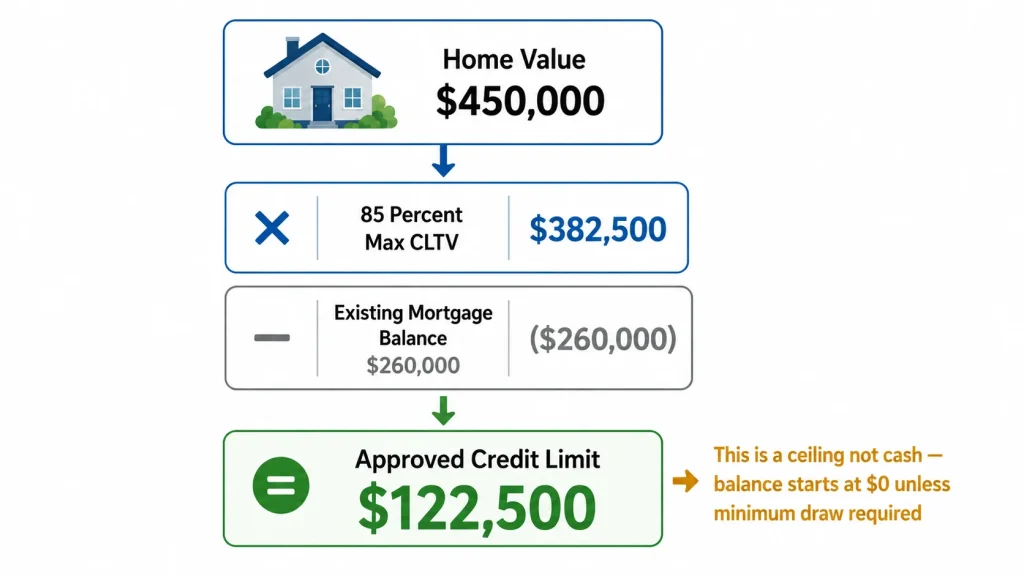
How the credit limit is calculated:
Credit Limit = (Home Value × Lender’s Max CLTV%) − Existing Mortgage Balance
Example:
Home value (per appraisal): $450,000 Lender’s maximum CLTV: 85% Existing mortgage balance: $260,000
$450,000 × 85% = $382,500 $382,500 − $260,000 = $122,500 approved credit limit
This $122,500 is your maximum. It is not money sitting in an account — it is the ceiling on what you can borrow. At this point, your HELOC balance is $0, and your monthly payment is $0, because you have not drawn anything yet.
Some lenders require a minimum initial draw at closing — commonly $10,000 to $25,000, or a percentage of the credit limit. If your lender has this requirement, your balance will not actually be zero on day one. Always ask about minimum draw requirements before closing if you want to start with a zero balance.
Phase 2: The Draw Period — How Borrowing Actually Works
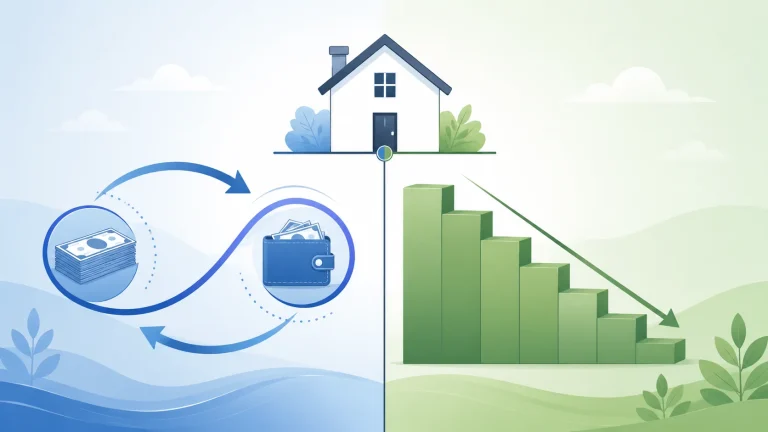
The draw period is the active phase of a HELOC — typically 5 to 10 years, with 10 years being most common at major lenders. During this period, you can borrow against your credit line, repay what you’ve borrowed, and borrow again, similar to a credit card.
How a Draw Works
You initiate a draw through your lender’s online portal, mobile app, by writing a HELOC check (if your lender provides them), by wire transfer, or sometimes through a direct payment to a third party like a contractor.
Funds are typically available within 1 to 3 business days for electronic transfers, same-day for some online lenders, or immediately if using a HELOC check or card linked to the account.
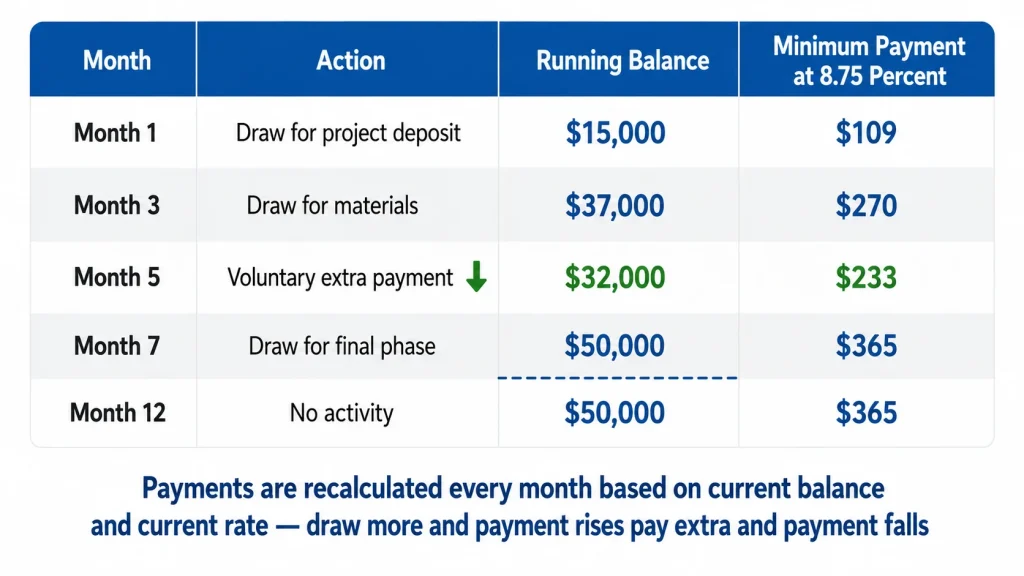
Example draw sequence over the first year:
| Month | Action | Draw Amount | Running Balance |
|---|---|---|---|
| Month 1 | Draw for project deposit | $15,000 | $15,000 |
| Month 3 | Draw for materials | $22,000 | $37,000 |
| Month 5 | Voluntary extra payment | -$5,000 | $32,000 |
| Month 7 | Draw for final phase | $18,000 | $50,000 |
| Month 12 | No activity | $0 | $50,000 |
Notice that the balance went down in month 5 because the borrower made a voluntary payment beyond the interest-only minimum. This is the revolving nature of a HELOC — your balance moves up and down based on your actual borrowing and repayment behavior, not on a fixed schedule.
How Payments Work During the Draw Period
Most lenders set the minimum payment during the draw period as interest-only — calculated fresh each month based on your current balance and current interest rate.
Minimum Payment = Current Balance × (Annual Rate ÷ 12)
Using the balance progression above, at an 8.75% interest rate:
| Month | Balance | Minimum Payment (Interest Only) |
|---|---|---|
| Month 1 | $15,000 | $109 |
| Month 3 | $37,000 | $270 |
| Month 5 | $32,000 | $233 |
| Month 7 | $50,000 | $365 |
| Month 12 | $50,000 | $365 |
Each month’s minimum payment is recalculated based on the balance at that time. If you draw more, next month’s minimum goes up. If you pay down principal, next month’s minimum goes down. If your rate changes — because HELOCs carry variable rates — your payment changes too, even if your balance stays the same.
This is the single most important thing to understand about draw period payments: they cover interest only, by default. Unless you pay more than the minimum, your balance does not decrease — ever — during the draw period.
What Happens If You Pay More Than the Minimum
Any payment above the interest-only minimum reduces your principal balance directly. There is no prepayment penalty on the vast majority of HELOCs for paying extra during the draw period.
If your minimum payment is $365 (on a $50,000 balance at 8.75%) and you pay $565, the extra $200 reduces your balance to $49,800. Next month’s interest calculation is based on $49,800, not $50,000 — a small but real reduction in your interest cost going forward.
Over time, these extra payments compound. A borrower who consistently pays $200 above the minimum throughout a 10-year draw period enters repayment with a meaningfully lower balance than one who paid only the minimum — which directly reduces the size of the payment shock at the transition to repayment.
The Transition: What Happens When the Draw Period Ends
This is the moment that defines the entire HELOC experience — and the one that catches unprepared borrowers off guard.
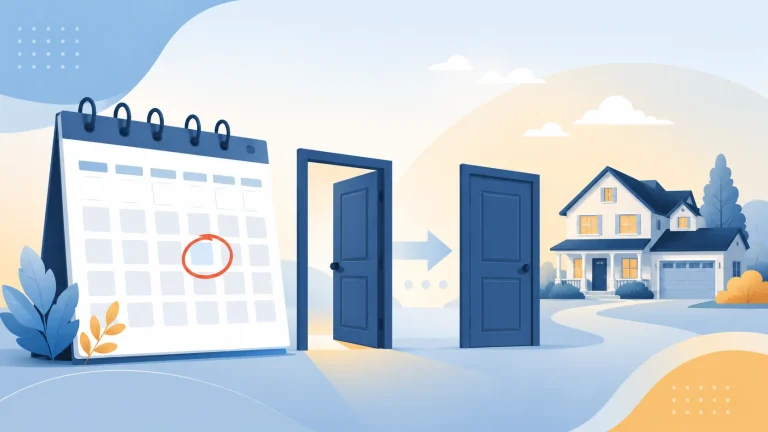
On a specific date — written into your original HELOC agreement, typically exactly 10 years (or 5 years) from when the HELOC was opened — the draw period ends. Two things happen simultaneously:
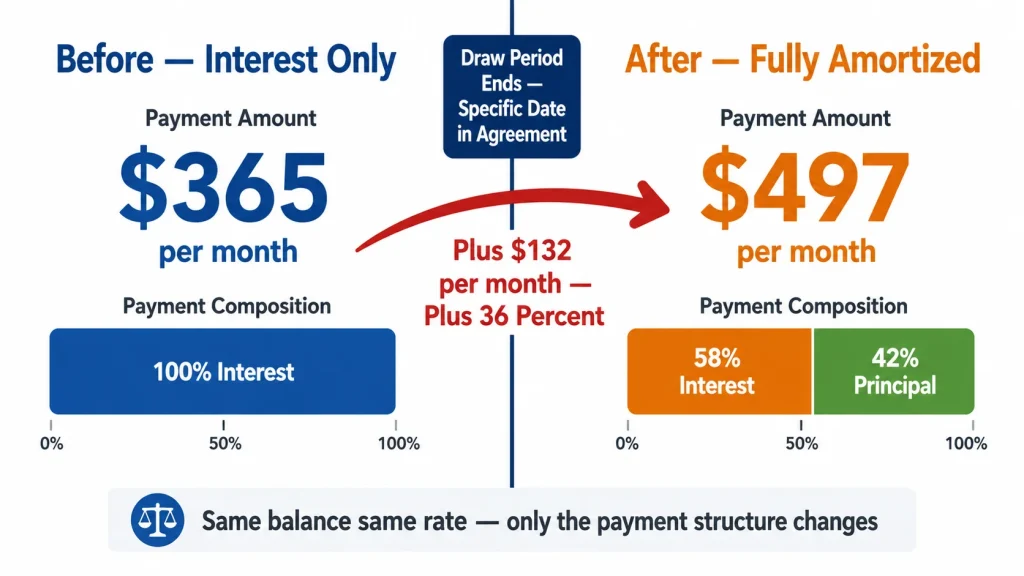
1. You can no longer draw new funds. The credit line closes for new borrowing. Whatever your balance is on that date is the balance you will repay.
2. Your payment structure changes completely. Instead of interest-only minimums, your payment becomes fully amortized — calculated to pay off the entire remaining balance, with interest, over the repayment period (typically 10, 15, or 20 years).
The Math Behind the Transition
The fully amortized payment is calculated using the standard loan amortization formula:
Monthly Payment = P × [r(1+r)^n] ÷ [(1+r)^n − 1]
Where P is your balance at the start of repayment, r is your monthly interest rate, and n is the number of months in your repayment term.
Example: Your balance at the end of the draw period is $50,000. Your rate is 8.75%. Your repayment term is 15 years (180 months).
Interest-only payment during draw period: $365/month Fully amortized payment during repayment: $497/month
The jump: +$132/month, or +36%.
This jump is not a penalty, a fee, or anything punitive — it is simply the mathematical reality of switching from “pay only the cost of borrowing” to “pay off the entire debt within a fixed timeframe.” But because the jump happens automatically, on a predetermined date, without any new paperwork or notification beyond a statement, many borrowers experience it as a sudden and unwelcome surprise.
This transition is significant enough that it has its own name in the HELOC world — payment shock — and its own dedicated strategies for managing it, covered in our article on HELOC Payment Shock.
Phase 3: The Repayment Period — How It Plays Out
Once the repayment period begins, your HELOC behaves much more like a traditional installment loan — similar to a mortgage or auto loan, but with one key difference: the interest rate is still variable.
Fixed Payment Schedule, Variable Rate
Your monthly payment is calculated at the start of repayment based on your balance and rate at that moment. But because HELOC rates are variable, your payment can be recalculated if your rate changes during the repayment period.
Some lenders recalculate the payment whenever the rate changes (keeping the payoff date fixed but the payment amount variable). Others keep the payment fixed and adjust the payoff date if the rate changes (similar to how a variable-rate mortgage might extend or shorten its term). Ask your specific lender which approach they use — it materially affects what to expect if rates move during your repayment period.
How the Balance Decreases Over Time
Unlike the draw period — where the balance can move in either direction based on your activity — the repayment period balance moves in only one direction: down. Every payment includes both interest and principal, and the proportion shifts over time.
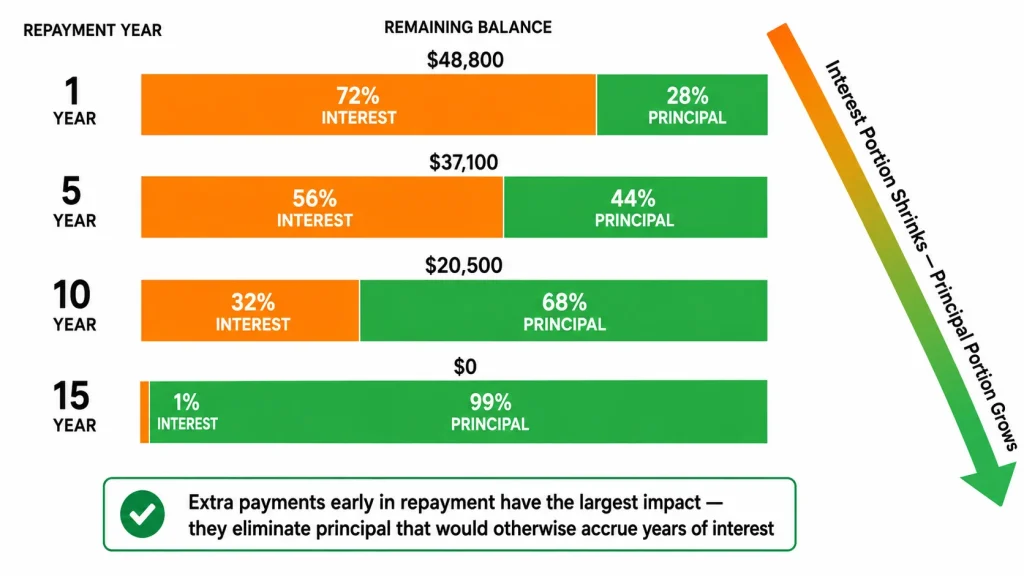
Early in repayment, most of your payment is interest because the balance is at its highest point. Late in repayment, most of your payment is principal because the balance has shrunk substantially.
On the $50,000 balance at 8.75% over 15 years:
| Repayment Year | Approximate Balance | Interest Portion of Payment | Principal Portion of Payment |
|---|---|---|---|
| Year 1 | $48,800 | $358 (72%) | $139 (28%) |
| Year 5 | $37,100 | $277 (56%) | $220 (44%) |
| Year 10 | $20,500 | $159 (32%) | $338 (68%) |
| Year 15 | $0 | $4 (1%) | $493 (99%) |
This is standard amortization behavior — the same pattern you’d see on a mortgage. The practical implication: extra payments made early in the repayment period have a much larger impact on total interest savings than extra payments made late, because they eliminate principal that would otherwise accrue interest for many more years.
A Complete Example: One HELOC From Start to Finish
Let’s trace a single HELOC through its entire life to see how all the pieces fit together.
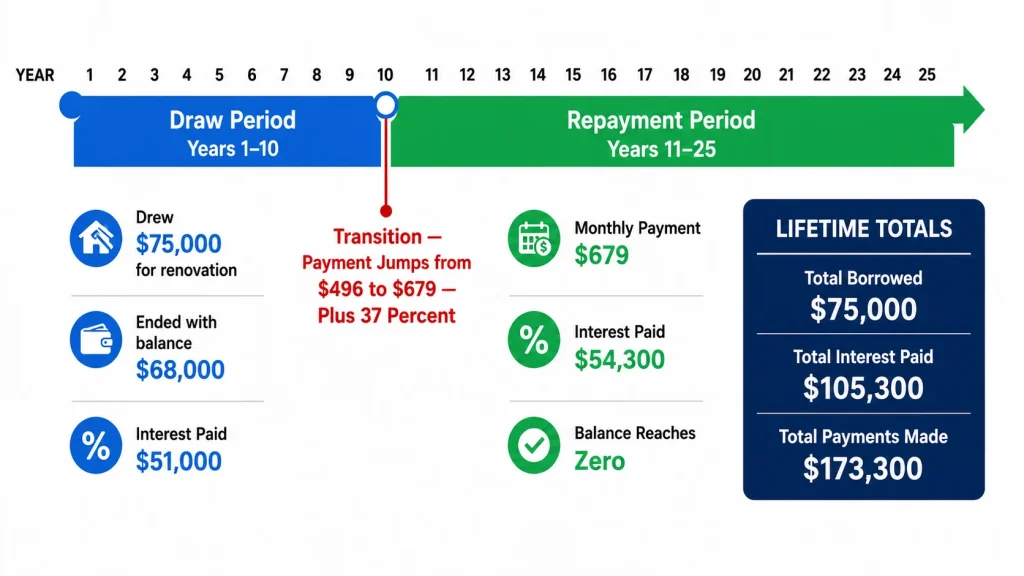
The setup:
- Home value: $450,000, existing mortgage $260,000
- Approved credit limit: $122,500
- Draw period: 10 years
- Repayment period: 15 years
- Rate: 8.75% (assumed constant for simplicity — in reality it would fluctuate)
Years 1–10 (draw period):
- Borrower draws $75,000 over the first three years for a home renovation
- Makes interest-only minimum payments most months
- Occasionally pays extra, ending the draw period with a balance of $68,000
- Total interest paid during draw period: approximately $51,000
Year 10 (transition):
- Draw period ends. Balance is $68,000.
- New monthly payment calculated: $68,000 at 8.75% over 15 years = $679/month
- Previous interest-only payment on $68,000 was $496/month
- Payment increase: +$183/month (+37%)
Years 11–25 (repayment period):
- Borrower pays $679/month consistently
- Total interest paid during repayment: approximately $54,300
- Balance reaches $0 in year 25 (15 years after repayment began)
Lifetime totals:
- Total borrowed: $75,000 (with some repayment along the way reducing it to $68,000 at transition)
- Total interest paid (both phases): approximately $105,300
- Total payments made: approximately $173,300
This is the full arc — from a $0 balance and $0 payment at opening, through active borrowing and interest-only payments, through the payment shock transition, through full amortization, to a $0 balance again 25 years later.
Why the Two-Phase Structure Exists
It’s worth understanding why HELOCs are built this way rather than just being a simple loan from day one.
The draw period exists because borrowing needs are often uncertain or staged. A homeowner doing a renovation doesn’t know exactly when each phase will need funding. A business owner with a HELOC for working capital needs flexible access, not a lump sum. The draw period gives lenders a way to extend a large credit commitment while only charging interest on what’s actually used.
The repayment period exists because lenders need the debt to eventually be fully repaid on a defined schedule. An indefinite interest-only arrangement would never reduce the lender’s risk exposure. The repayment period converts the flexible credit line into a standard amortizing loan that resolves to zero on a known date.
The combination gives borrowers genuine flexibility during the years when they need it most, while ensuring the debt has a defined endpoint — as long as borrowers understand and plan for the transition between the two.
What This Means for You as a Borrower
Three practical takeaways from understanding the full mechanics:
Know your dates. Your HELOC agreement specifies the exact draw period length and repayment period length. Write down the date your draw period ends. That date is more important than almost any other number in your HELOC paperwork.
Treat the interest-only minimum as a floor, not a target. The minimum payment is the least you can pay — not a recommendation. Every dollar above the minimum during the draw period directly reduces the balance that will determine your repayment payment.
Recalculate periodically. Because rates are variable and your balance changes with your activity, your eventual repayment payment is not a fixed number you can calculate once and forget. Revisit it — using our HELOC Payment Calculator — at least annually, and especially in the 12 to 24 months before your draw period ends.
The Bottom Line
A HELOC works in three phases: a credit line gets established based on your equity, you draw and repay funds flexibly for 5 to 10 years while paying interest-only minimums, and then the line closes to new borrowing and your remaining balance converts to a fixed amortization schedule over 10 to 20 years.
The mechanics are not complicated once you see the full picture — but the transition between phases two and three is where most of the real-world financial impact happens. A 36% payment increase is the norm, not the exception, and it happens automatically on a date set at the very beginning.
Understanding this upfront — and using the draw period intentionally rather than passively — is what separates borrowers who use a HELOC as an efficient financial tool from those who are caught off guard by its second act.
Use our HELOC Payment Calculator to model your own draw and repayment scenario, including what your payment will look like at every stage of the process.