HELOC Draw Period vs. Repayment Period: Key Differences
Every HELOC has two acts, and they could not be more different from each other. The draw period is flexible, forgiving, and inexpensive. The repayment period is fixed, structured, and significantly more expensive on a monthly basis. Confusing the two — or not fully grasping what changes between them — is the single most common source of HELOC-related financial surprise.
This article puts the two periods side by side so the differences are unmistakable: what you can and cannot do, how payments are calculated, what your balance does over time, and what the actual dollar impact looks like when one ends and the other begins.
The Core Distinction in One Sentence
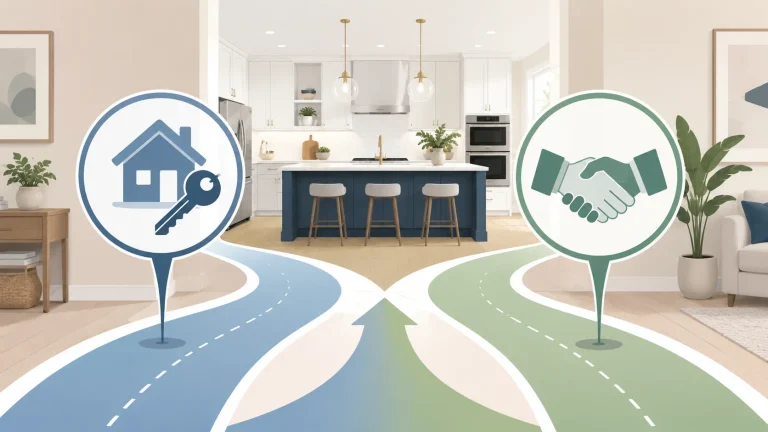
During the draw period, you can borrow, repay, and borrow again, paying interest only on what you’ve drawn. During the repayment period, you cannot borrow anything new, and you must pay down the entire remaining balance — principal and interest — by a fixed date.
Everything else flows from that single distinction.
Side-by-Side Comparison
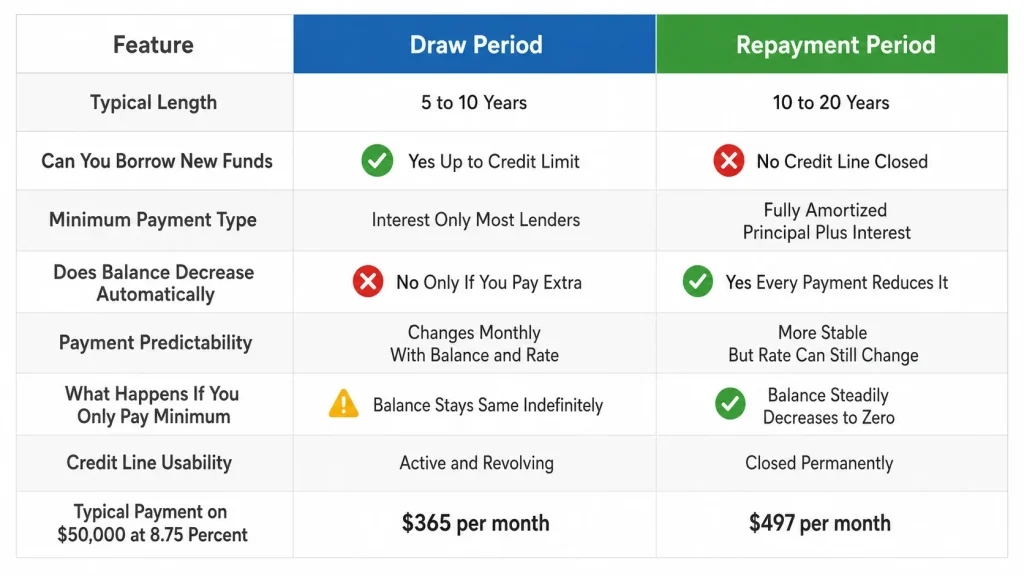
| Feature | Draw Period | Repayment Period |
|---|---|---|
| Typical length | 5–10 years | 10–20 years |
| Can you borrow new funds? | Yes, up to credit limit | No — credit line is closed |
| Minimum payment type | Interest-only (most lenders) | Fully amortized (principal + interest) |
| Does balance decrease automatically? | No — only if you pay extra | Yes — every payment reduces it |
| Payment predictability | Changes monthly with balance/rate | More stable, but rate can still change |
| What happens if you only pay minimum | Balance stays the same indefinitely | Balance steadily decreases to zero |
| Credit line usability | Active and revolving | Closed permanently |
| Typical payment on $50,000 at 8.75% | $365/month | $497/month (15-year term) |
The Draw Period: What It Actually Allows
Think of the draw period as the “credit card phase” of your HELOC. You have an approved limit, and you can use it flexibly.
What you can do:
- Draw funds as needed, in any amount up to your available credit
- Repay drawn amounts at any time, restoring that credit for future use
- Make multiple draws for multiple purposes over the years
- Pay only the interest-only minimum if cash flow requires it
- Pay extra at any time with no prepayment penalty at most lenders
What governs your payment:
The minimum payment is recalculated every billing cycle based on your current outstanding balance and current interest rate:
Minimum Payment = Outstanding Balance × (Annual Rate ÷ 12)
This means your payment is genuinely variable in two dimensions — it changes when your balance changes (because you drew more or paid some down) and it changes when your rate changes (because the prime rate moved). A borrower who never draws beyond an initial amount and never sees rate changes might have a stable payment for years. A borrower who draws repeatedly and faces a rising-rate environment will see their payment shift regularly.
The behavior that defines this period: your balance does not move unless you actively change it. There’s no automatic principal reduction built into the minimum payment. This is the most counterintuitive part of a HELOC for first-time borrowers used to mortgages or auto loans, where every payment chips away at the balance by design.
The Repayment Period: What Changes Completely
When the draw period ends — on the exact date specified in your original loan agreement — the entire structure flips.
What changes immediately:
- The credit line closes. You cannot draw any more funds, regardless of how much you’ve repaid.
- Your minimum payment becomes fully amortized — calculated to pay off the entire balance, plus interest, by the end of the repayment term.
- Your balance now decreases with every single payment, automatically, without any extra effort on your part.
What governs your payment:
The fully amortized payment uses the standard loan amortization formula, based on your balance at the moment repayment begins, your current interest rate, and the length of your repayment term:
Monthly Payment = P × [r(1+r)^n] ÷ [(1+r)^n − 1]
This payment is recalculated once at the start of repayment (and potentially again if your lender adjusts for rate changes during the term — practices vary by lender). It’s far more structured than the draw period payment, but it is still not entirely fixed, because the underlying rate is still variable.
The behavior that defines this period: every payment reduces your balance, whether you want it to or not. There’s no way to “pause” the principal reduction the way you could during the draw period by paying only interest. The structure forces debt elimination on a defined schedule.
The Dollar Impact: Same Balance, Two Very Different Payments
The clearest way to see the difference is to look at the exact same balance under both structures.
$60,000 balance at 8.75% interest:
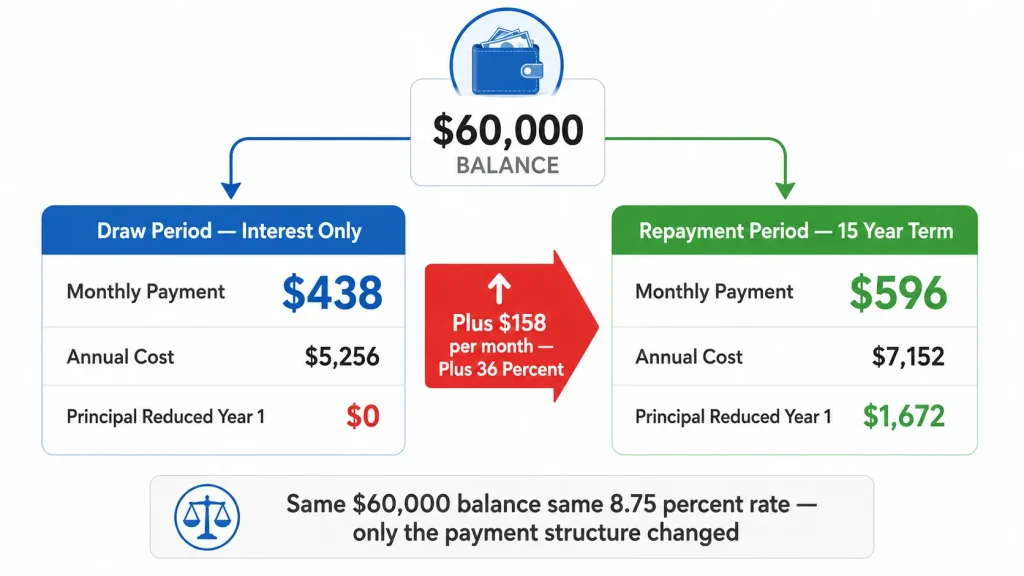
| Draw Period (Interest-Only) | Repayment Period (15-Year Term) | |
|---|---|---|
| Monthly payment | $438 | $596 |
| Annual cost | $5,256 | $7,152 |
| Principal reduced in year 1 | $0 | $1,672 |
| Difference | — | +$158/month, +36% |
That 36% increase is not a fee, a penalty, or anything imposed because you did something wrong. It’s the mathematical difference between “cover the interest” and “pay off the entire debt within a fixed window.” But because the increase happens automatically and all at once, it is the most jarring moment in the life of a typical HELOC.
This jump has its own name in the industry — payment shock — covered in detail in our dedicated article on HELOC Payment Shock.
How the Length of Each Period Affects Your Total Cost
The length of your draw period and repayment period are set when you open the HELOC, and they materially affect your total interest cost over the life of the loan.
Draw Period Length
A longer draw period (e.g., 10 years vs. 5 years) gives you more time to borrow flexibly — but it also gives you more time to accumulate interest charges if you only pay the minimum, since the balance isn’t required to decrease during this phase.
A shorter draw period (5 years) forces you into repayment sooner, which might feel premature if you’re still using the credit line actively, but it also limits how long you can coast on interest-only payments.
Repayment Period Length
A longer repayment period (20 years) produces a lower monthly payment but meaningfully more total interest, because the balance takes longer to pay down and accrues interest for more years.
A shorter repayment period (10 years) produces a higher monthly payment but substantially less total interest.
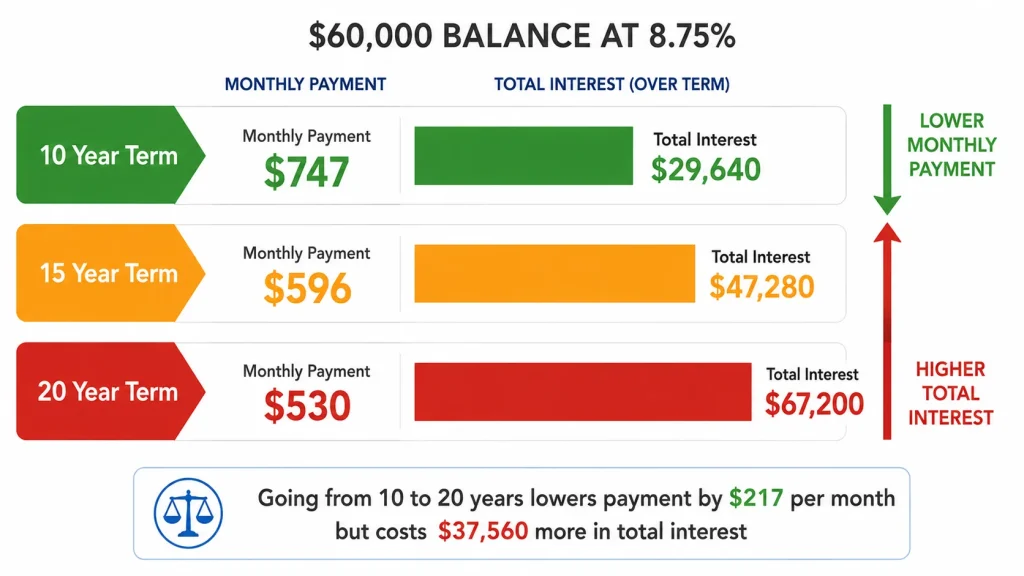
Example: $60,000 balance at 8.75%, comparing repayment terms:
| Repayment Term | Monthly Payment | Total Interest Paid |
|---|---|---|
| 10 years | $747 | $29,640 |
| 15 years | $596 | $47,280 |
| 20 years | $530 | $67,200 |
Going from a 10-year to a 20-year repayment term lowers the monthly payment by $217 but increases total interest by $37,560. This is a tradeoff worth understanding before you choose a HELOC structure — some lenders let you select your repayment term, others have it fixed in the standard product.
Can You Influence What Happens at the Transition?
To some degree, yes. While the dates are fixed once the HELOC is opened, your behavior during the draw period directly shapes how painful the transition feels.
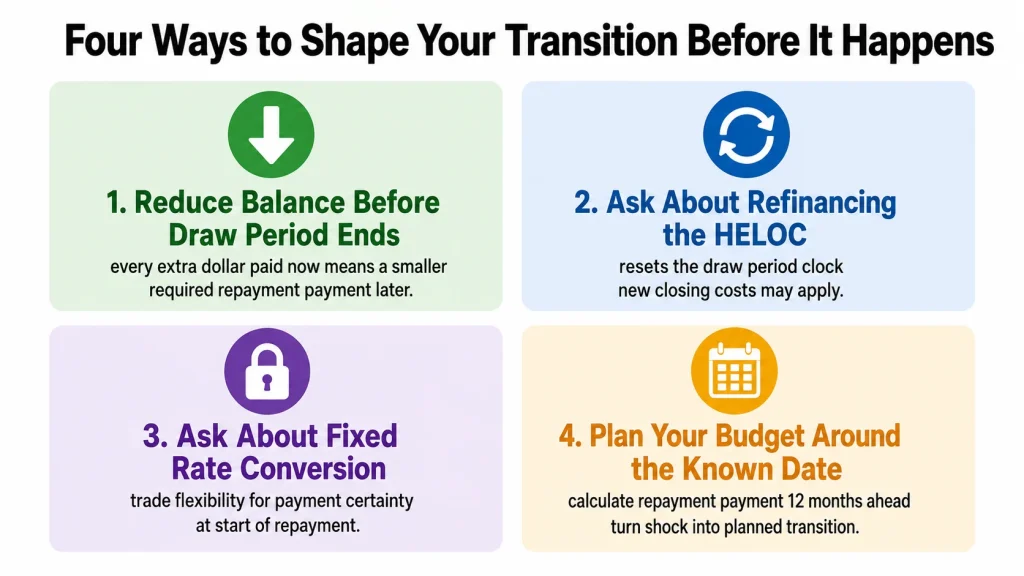
Reduce your balance before the draw period ends. Every dollar of principal you pay down during the draw period is a dollar that won’t be part of the balance that gets amortized into your repayment payment. A borrower who pays extra throughout the draw period enters repayment with a smaller balance and therefore a smaller required payment.
Ask about refinancing the HELOC before repayment begins. Some lenders allow you to refinance an existing HELOC into a new one — effectively resetting the draw period clock. This isn’t free (new closing costs may apply) and it delays rather than eliminates the eventual need to repay, but it’s an option if your circumstances have changed.
Ask about converting to a fixed-rate loan. Some lenders allow you to convert all or part of your HELOC balance into a fixed-rate installment loan at the start of repayment, trading away the (already gone) flexibility of the draw period for payment certainty going forward.
Plan your budget around the known transition date. Even if you can’t change the math, you can prepare for it. Knowing your repayment payment 12 months in advance — using our HELOC Payment Calculator — and adjusting your budget accordingly turns a shock into a planned transition.
A Common Misconception Worth Clearing Up
Some borrowers assume that because they’ve been making payments throughout the draw period, their balance must have been going down the whole time. This is not automatically true.
If you paid exactly the interest-only minimum every month for 10 years, your balance at the start of repayment is the same as it was after your last draw. You paid tens of thousands of dollars in interest over that decade — and your principal balance did not move.
This isn’t a flaw in the product. It’s simply how interest-only payments work, and it’s why financial advisors consistently recommend paying more than the minimum whenever your budget allows during the draw period — not because the minimum is wrong, but because it’s a floor, not a strategy.
The Bottom Line
The draw period and repayment period are not two variations of the same experience — they are functionally two different loans stitched together by a single credit line. The draw period rewards flexibility and active borrowing; the repayment period demands structured, automatic debt reduction.
Understanding exactly when one ends and the other begins — and what your payment will look like on both sides of that line — is the difference between a HELOC that serves your financial goals and one that ambushes you with an unexpected payment increase right when you’ve stopped paying attention to it.
Use our HELOC Payment Calculator to see your specific numbers on both sides of the transition, based on your actual balance, rate, and chosen repayment term.