How is HELOC Interest Calculated? Step-by-Step
Every HELOC statement shows an interest charge for the month, but very few borrowers actually understand where that number comes from. It isn’t arbitrary, and it isn’t calculated the same way a fixed-rate loan calculates interest. HELOCs typically accrue interest daily, based on your actual balance each day, then total it up at the end of the billing cycle.
This article breaks the calculation down to its actual mechanics — the formula, the daily accrual process, what happens when your balance or rate changes mid-cycle, and several fully worked examples so you can verify your own statement against the math.
The Basic Formula
At the most basic level, HELOC interest for a billing period is calculated as:
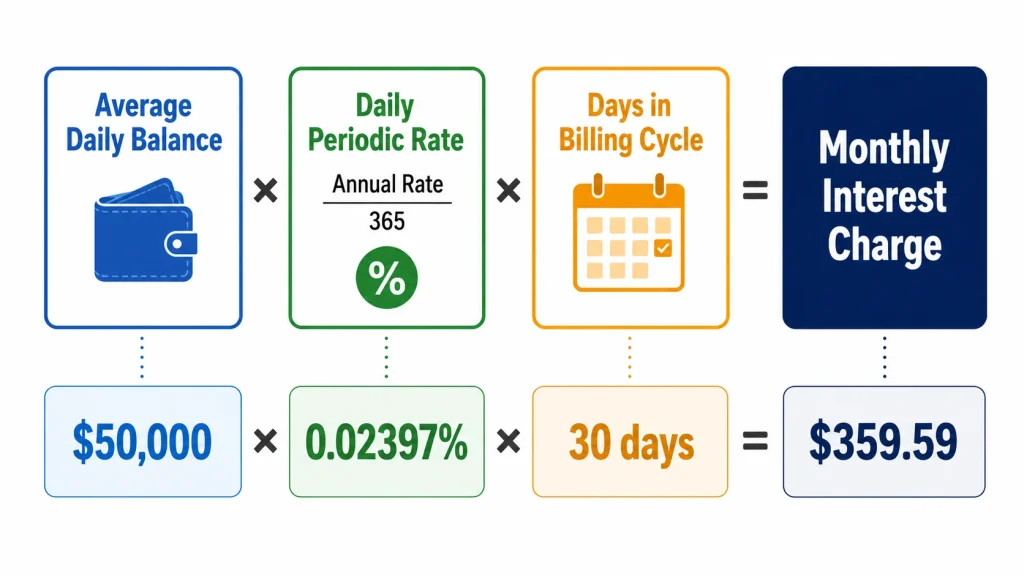
Interest = Average Daily Balance × Daily Periodic Rate × Number of Days in Billing Cycle
Where the daily periodic rate is your annual interest rate divided by 365 (or 360, depending on the lender’s day-count convention):
Daily Periodic Rate = Annual Interest Rate ÷ 365
This is different from a simple “balance times monthly rate” shortcut that some people use for quick estimates. That shortcut gets you close, but the actual calculation most lenders use is based on daily accrual — which matters most when your balance changes during the month.
Step-by-Step: How a Single Day’s Interest Accrues
Let’s break the calculation into its smallest unit — a single day.
Step 1: Determine the day’s outstanding balance.
This is whatever you owe on that specific calendar day, including any draws or payments that posted that day.
Step 2: Determine the day’s interest rate.
HELOCs carry variable rates tied to an index — usually the Wall Street Journal Prime Rate — plus a fixed margin set by your lender. On most days the rate doesn’t change; it changes only when the underlying index moves (the Fed adjusts rates) or, in rare cases, when your lender repriced your margin.
Step 3: Calculate the daily periodic rate.
Divide the annual rate by 365 (or 360 for lenders using that convention).
Step 4: Multiply.
Daily Interest = Balance That Day × (Annual Rate ÷ 365)
Worked example for a single day:
Balance: $50,000 Annual rate: 8.75% Daily periodic rate: 8.75% ÷ 365 = 0.02397%
Daily interest = $50,000 × 0.0002397 = $11.99
This $11.99 is added to a running total for the billing cycle. Multiply by roughly 30 days (with adjustments for any balance changes) and you get your monthly interest charge.
Step-by-Step: A Full Billing Cycle With a Steady Balance
If your balance doesn’t change at all during the month, the calculation simplifies nicely.
Example: $50,000 balance held steady for a 30-day billing cycle at 8.75%
Daily interest: $50,000 × (8.75% ÷ 365) = $11.99 30-day total: $11.99 × 30 = $359.70
This is very close to the “balance × annual rate ÷ 12” shortcut ($50,000 × 8.75% ÷ 12 = $364.58), but not identical — the small difference comes from the actual number of days in the billing cycle versus a flat 1/12 assumption. A 31-day cycle will produce slightly more interest than a 28-day cycle even with an identical balance and rate, because interest accrues daily, not monthly.
Step-by-Step: A Billing Cycle With a Mid-Month Draw
This is where daily accrual actually matters and produces a result that a simple monthly shortcut would get wrong.
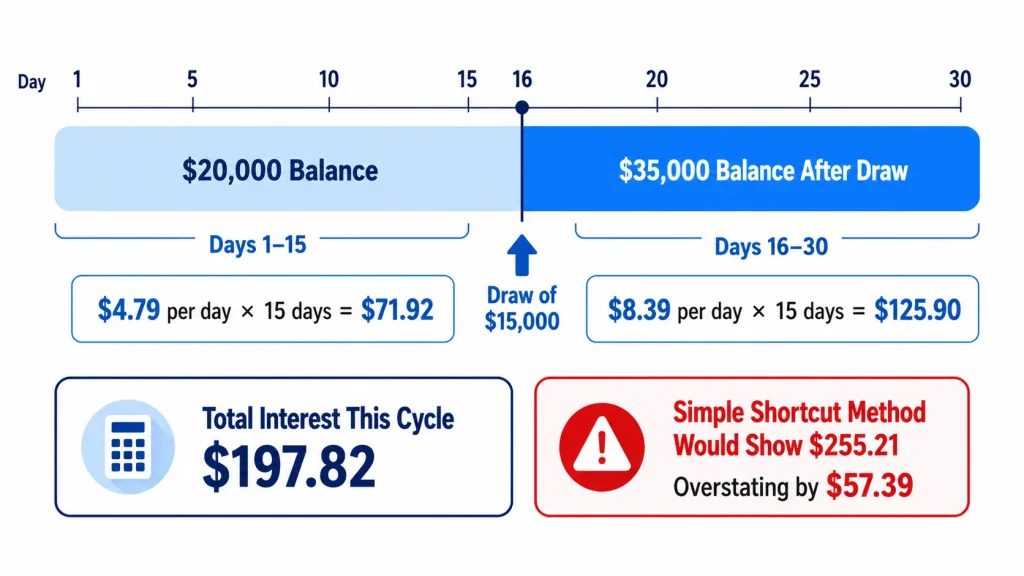
Example: Your balance is $20,000 for the first 15 days of the billing cycle. On day 16, you draw an additional $15,000, bringing your balance to $35,000 for the remaining 15 days of a 30-day cycle. Rate is 8.75% throughout.
Days 1–15 (balance $20,000): Daily interest: $20,000 × (8.75% ÷ 365) = $4.79 15-day subtotal: $4.79 × 15 = $71.92
Days 16–30 (balance $35,000): Daily interest: $35,000 × (8.75% ÷ 365) = $8.39 15-day subtotal: $8.39 × 15 = $125.90
Total interest for the cycle: $71.92 + $125.90 = $197.82
If you tried to estimate this using a simple “ending balance × monthly rate” shortcut, you’d calculate $35,000 × (8.75% ÷ 12) = $255.21 — overstating the actual interest by more than $57, because that approach incorrectly assumes the higher balance applied for the entire month rather than just the back half.
This is exactly why your statement might show a number that doesn’t match a quick mental calculation based on your current balance — the statement reflects the actual daily history of your balance, not a snapshot.
Step-by-Step: What Happens When Your Rate Changes Mid-Cycle
HELOC rates change when the underlying index (typically the prime rate) moves. When the Federal Reserve adjusts the federal funds rate, the prime rate typically follows within a day or two, and your HELOC rate adjusts according to the terms in your agreement — often on a specific date such as the first of the next billing cycle, though this varies by lender.
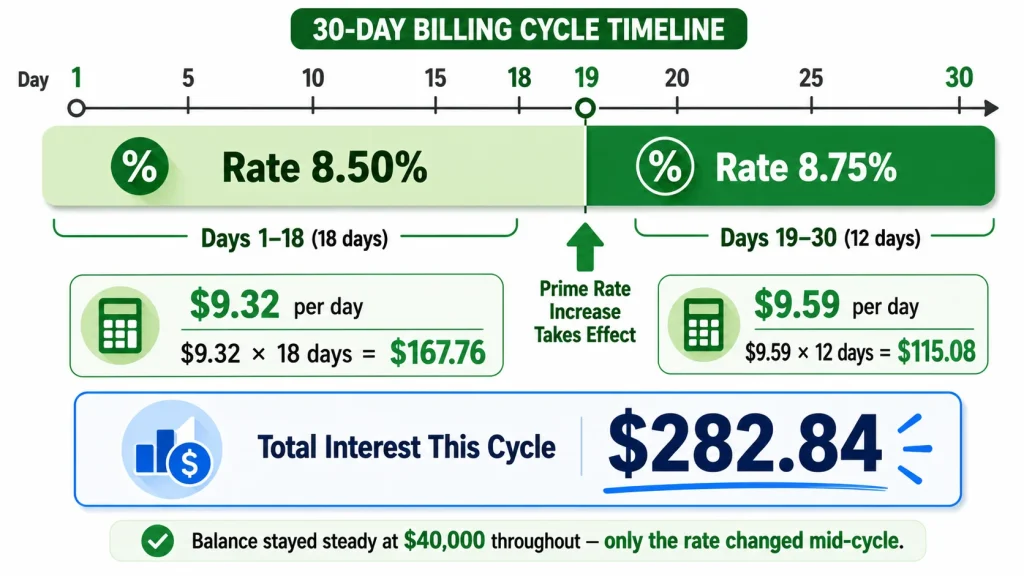
Example: Your balance is a steady $40,000 for a full 30-day cycle. The rate is 8.50% for the first 18 days, then increases to 8.75% for the remaining 12 days following a prime rate increase.
Days 1–18 (rate 8.50%): Daily interest: $40,000 × (8.50% ÷ 365) = $9.32 18-day subtotal: $9.32 × 18 = $167.76
Days 19–30 (rate 8.75%): Daily interest: $40,000 × (8.75% ÷ 365) = $9.59 12-day subtotal: $9.59 × 12 = $115.08
Total interest for the cycle: $167.76 + $115.08 = $282.84
Most lenders apply rate changes on a specific, predetermined date (often tied to when the index officially changes, with a brief lag), rather than retroactively. Check your loan agreement for the specific timing — some lenders apply changes immediately, others on the first day of the next billing cycle regardless of when mid-cycle the index moved.
Average Daily Balance: The Method Most Lenders Actually Use
Rather than tracking every single day’s interest individually (which produces the same result but is tedious to display), most lenders summarize the calculation using the average daily balance method:
Interest = Average Daily Balance × Annual Rate ÷ 365 × Number of Days in Cycle
The average daily balance is simply the sum of each day’s balance divided by the number of days in the cycle.
Using the mid-month draw example from earlier:
Sum of daily balances: ($20,000 × 15 days) + ($35,000 × 15 days) = $300,000 + $525,000 = $825,000 Average daily balance: $825,000 ÷ 30 days = $27,500
Interest = $27,500 × (8.75% ÷ 365) × 30 = $27,500 × 0.0002397 × 30 = $197.78
(The small four-cent difference from our earlier $197.82 calculation is simply rounding — both methods produce essentially the same result. The average daily balance method is just a more efficient way to express the same daily-accrual math.)
This is the number you’ll typically see referenced on your monthly statement as “Average Daily Balance,” alongside the interest charged for the cycle.
Why Some Months Show Slightly Different Interest Even at the Same Balance
If you hold a perfectly steady balance and the rate never changes, you might still notice your interest charge varies slightly from month to month. This is because billing cycles don’t all have the same number of days.
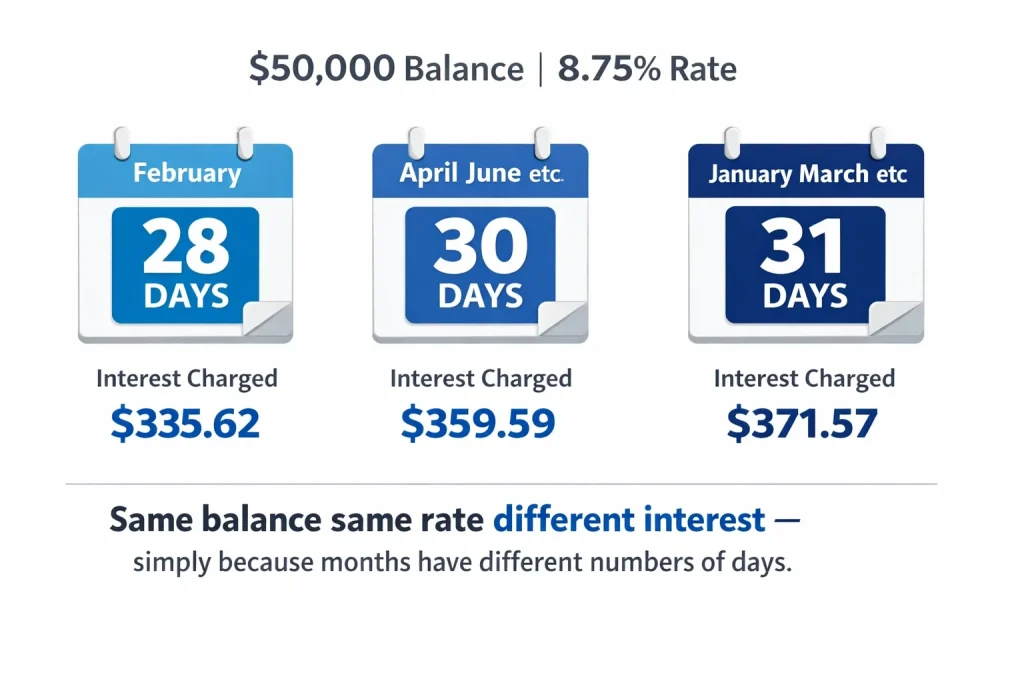
Example: $50,000 steady balance at 8.75% across different cycle lengths
| Days in Cycle | Interest Charged |
|---|---|
| 28 days (February, non-leap) | $335.62 |
| 30 days (April, June, etc.) | $359.59 |
| 31 days (January, March, etc.) | $371.57 |
A borrower might see their February statement show less interest than their March statement despite an identical balance and rate — simply because February has fewer days. This is normal and not an error.
How Lenders Differ: 365/365 vs. 365/360 Day-Count Conventions
Most HELOC lenders use a 365/365 day-count convention — dividing the annual rate by 365 regardless of leap years, and counting actual days in each cycle. A smaller number of lenders, more commonly seen in commercial lending, use a 365/360 convention — dividing the annual rate by 360 but still counting actual days, which produces a slightly higher effective rate than the stated rate.
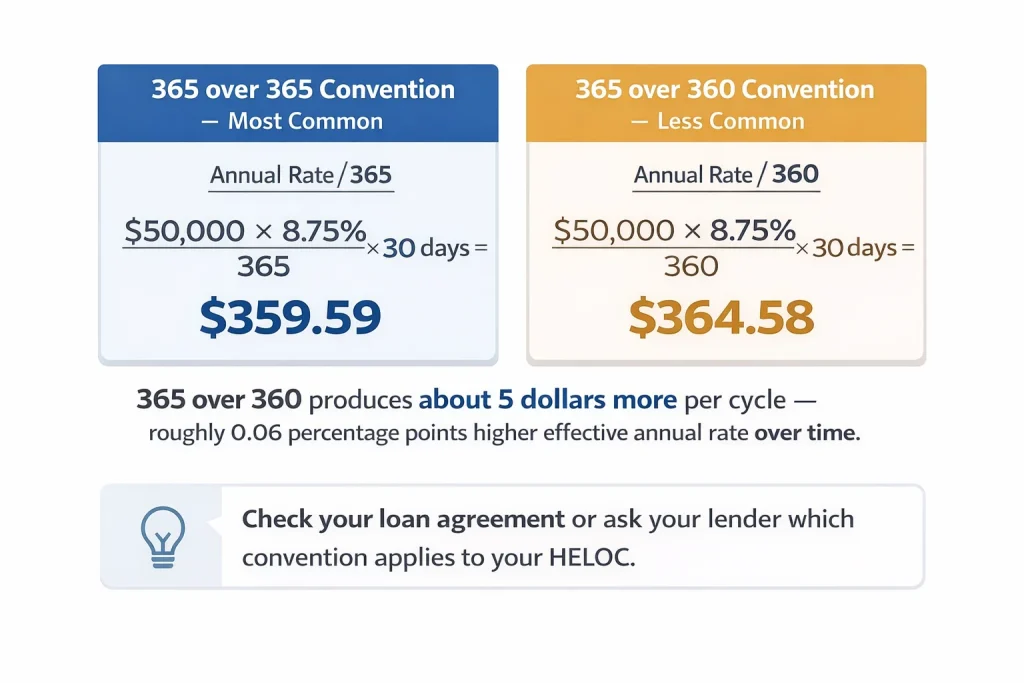
Comparing the two on the same example: $50,000 balance, 8.75% rate, 30-day cycle
365/365 method: $50,000 × (8.75% ÷ 365) × 30 = $359.59 365/360 method: $50,000 × (8.75% ÷ 360) × 30 = $364.58
The 365/360 method produces about $5 more interest per cycle on this balance — a small amount per month, but it compounds to a meaningfully higher effective annual rate over time (roughly 0.06 percentage points higher than the stated rate). Check your loan agreement or ask your lender directly which convention applies to your HELOC.
Verifying Your Own Statement
If you want to check your lender’s math against your own calculation, here’s the practical process:
Step 1: Find your average daily balance for the billing cycle (most statements display this directly).
Step 2: Find your interest rate for that cycle (also typically shown on the statement).
Step 3: Find the number of days in the billing cycle (check your statement dates).
Step 4: Calculate: Average Daily Balance × (Annual Rate ÷ 365) × Number of Days
Step 5: Compare your result to the interest charge shown on the statement.
Small discrepancies of a few cents are typically rounding. Larger discrepancies are worth calling your lender about — they could indicate a rate that wasn’t updated correctly, a draw or payment that posted on the wrong date, or a day-count convention different from what you assumed.
What This Means for Managing Your HELOC
Understanding the actual mechanics of interest accrual has a few practical implications.
Timing matters more than people realize. Because interest accrues daily on your actual balance, paying down principal earlier in a billing cycle — rather than waiting until the due date — genuinely reduces your interest cost, even within the same month. A payment made on day 5 instead of day 25 reduces the balance for an extra 20 days of accrual.
Draws timed late in a cycle cost less interest that cycle. If you have flexibility on when to draw funds, drawing on day 25 instead of day 5 of a 30-day cycle means only 5 days of interest accrue at the higher balance that cycle, rather than 25.
Rate changes apply going forward, not retroactively (in nearly all cases). A rate increase announced today does not change interest that already accrued on your existing balance in prior cycles.
The “average daily balance × annual rate ÷ 12” shortcut is a reasonable estimate but not exact. Use it for quick mental math, but don’t expect it to match your statement to the penny — especially in cycles where your balance changed.
The Bottom Line
HELOC interest accrues daily based on your actual outstanding balance, using a daily periodic rate derived from your annual rate. Lenders typically summarize this as an “average daily balance” calculation, which produces the same result as tracking every individual day but is easier to display on a statement.
The practical upshot: your balance history within a billing cycle — not just your balance on any single day — determines your interest charge. Paying down principal early in a cycle, timing draws strategically, and understanding your lender’s specific day-count convention all have small but real effects on what you actually pay.
Use our HELOC Payment Calculator to estimate your interest costs across different balance and rate scenarios, and compare the result against your own statement to confirm everything is calculating as expected.