
What is a HELOC Credit Limit and How is it Set?
The credit limit a lender offers you is not a number they pull from a general formula applied equally to everyone. It is the output of a specific calculation involving your home’s appraised value, your existing mortgage balance, your lender’s risk tolerance, and — often overlooked — your income and credit profile, which can reduce the theoretical maximum even when your equity would support more.
Understanding exactly how this number gets calculated helps you do two things: estimate your own limit before you apply, and recognize when an offer seems unusually low (or generous) relative to your equity position.
The Core Formula
Every HELOC credit limit starts with the same basic equation:
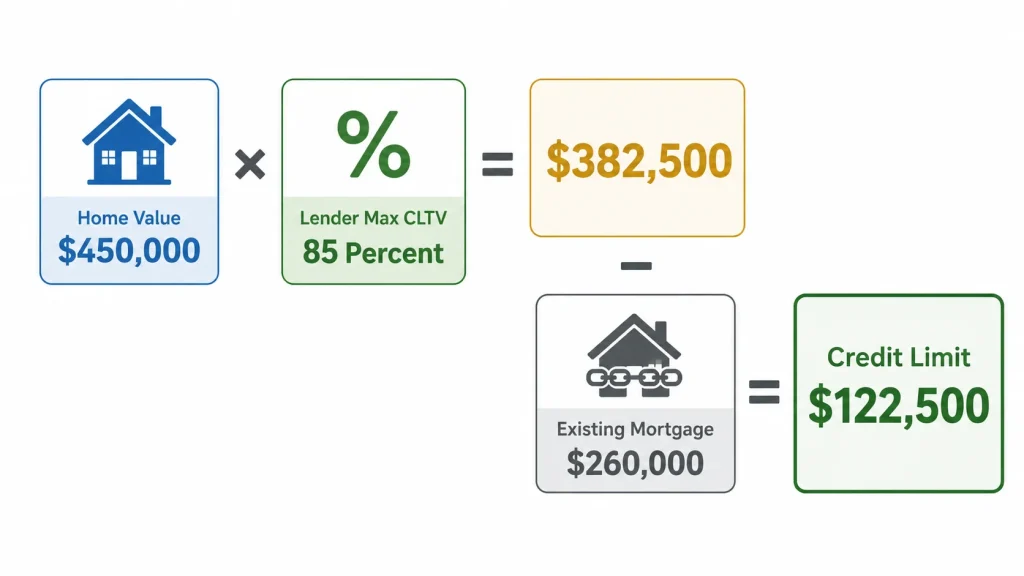
Credit Limit = (Home Value × Lender’s Maximum CLTV%) − Existing Mortgage Balance
CLTV stands for combined loan-to-value — the total of all debt secured by your home (your first mortgage plus the new HELOC) expressed as a percentage of the home’s value. Lenders set a maximum CLTV they’re willing to extend credit up to, typically in the 80% to 85% range in 2026, though it varies by lender and borrower profile.
A basic example:
Home value: $450,000 Lender’s maximum CLTV: 85% Existing mortgage balance: $260,000
$450,000 × 85% = $382,500 $382,500 − $260,000 = $122,500 theoretical maximum credit limit
This is the starting point — the absolute ceiling based on equity alone. Whether you’re actually offered this full amount depends on several other factors.
Factor 1: The Appraised Value (Not Your Estimate)
The “home value” in the formula above isn’t what you think your house is worth, what a real estate website estimates, or what you paid for it. It’s the value determined by the lender’s appraisal process — which could be a full interior appraisal, a drive-by appraisal, or an automated valuation model (AVM), depending on your lender and property.
This matters because appraised values and owner estimates frequently diverge — sometimes significantly. A homeowner who believes their home is worth $480,000 based on a real estate site’s algorithm might receive an appraisal of $450,000 — a $30,000 difference that reduces their maximum HELOC by approximately $25,500 at an 85% CLTV.
Why appraisals can come in lower than expected:
- The online estimate didn’t account for needed repairs or deferred maintenance
- Recent comparable sales in the area were lower than the homeowner assumed
- The home has unique features that are harder to value (unusual layout, partial renovations)
- Market conditions shifted between when the homeowner checked an estimate and when the appraisal occurred
If your appraisal comes back lower than expected, you can request a reconsideration of value with supporting comparable sales data, but the appraisal — not your own estimate — is what the lender uses in the formula.
Factor 2: Your Lender’s Maximum CLTV Percentage
Not all lenders use the same maximum CLTV. This single variable can change your available credit limit by tens of thousands of dollars between lenders, even on an identical property.

| Lender’s Max CLTV | Credit Limit on $450,000 Home, $260,000 Mortgage |
|---|---|
| 75% | $77,500 |
| 80% | $100,000 |
| 85% | $122,500 |
| 90% | $145,000 |
A lender offering 90% CLTV will extend nearly twice the credit limit of a lender offering 75% CLTV on the exact same property. This is one of the most important things to compare when shopping multiple lenders — not just the rate, but the maximum CLTV they’re willing to extend.
What influences a lender’s maximum CLTV offer to you specifically:
- Your credit score (higher scores often unlock higher CLTV tiers)
- Property type (primary residences typically get higher CLTV than second homes or investment properties)
- Whether the property is in a high-cost or volatile market (some lenders cap CLTV lower in markets they consider higher risk)
- Your debt-to-income ratio
- The lender’s own institutional risk appetite and current lending environment
Factor 3: Income and Debt-to-Income Ratio
Even if your equity position would support a $150,000 credit limit, your lender will not extend that much credit if your income can’t support the resulting payment obligations under their debt-to-income (DTI) guidelines.
Lenders generally cap total monthly debt — including the projected HELOC payment — at 43% of gross monthly income, though this varies.
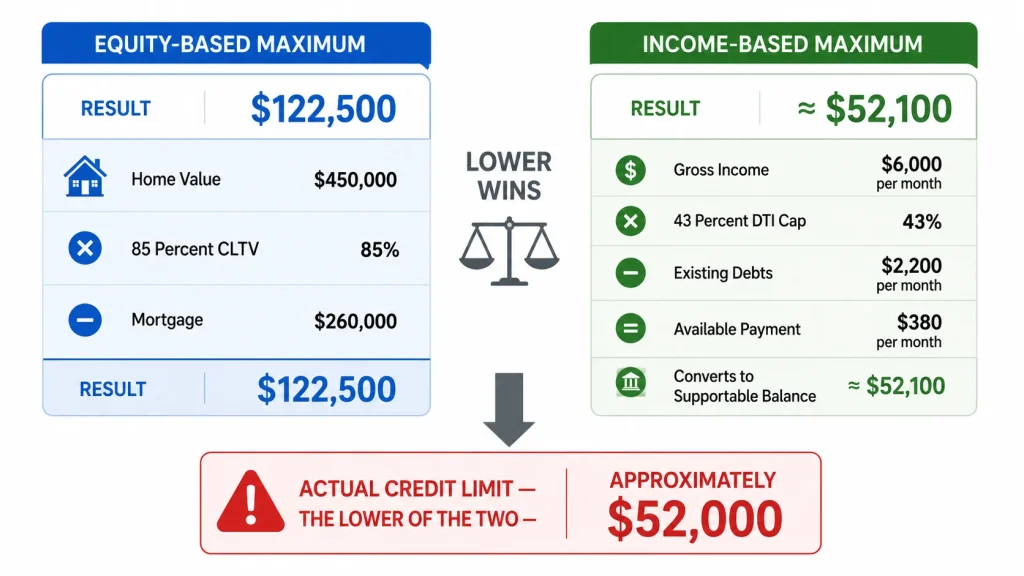
Example where income limits the credit line below the equity-based maximum:
Equity-based maximum: $122,500 Borrower’s gross monthly income: $6,000 Existing monthly debts: $2,200 (mortgage, car loan, student loan, credit cards)
Maximum total debt at 43% DTI: $6,000 × 0.43 = $2,580 Available room for new HELOC payment: $2,580 − $2,200 = $380/month
At an interest-only minimum payment structure, $380/month at 8.75% supports a balance of approximately: $380 ÷ (8.75% ÷ 12) = approximately $52,100
In this scenario, even though the home’s equity would support a $122,500 credit limit, the borrower’s income and existing debt only support roughly $52,000 in actual borrowing capacity under standard DTI guidelines. The lender may approve a credit limit closer to this income-supported figure rather than the full equity-based maximum — or decline to extend the full equity-based amount and offer a reduced limit instead.
This is one of the most common reasons borrowers are surprised when their approved credit limit comes in well below what they calculated using the equity formula alone.
Factor 4: Credit Score Tiers
Many lenders use tiered credit score brackets that affect not just your interest rate but your available credit limit and maximum CLTV.
A simplified illustration of how this might work at a typical lender:
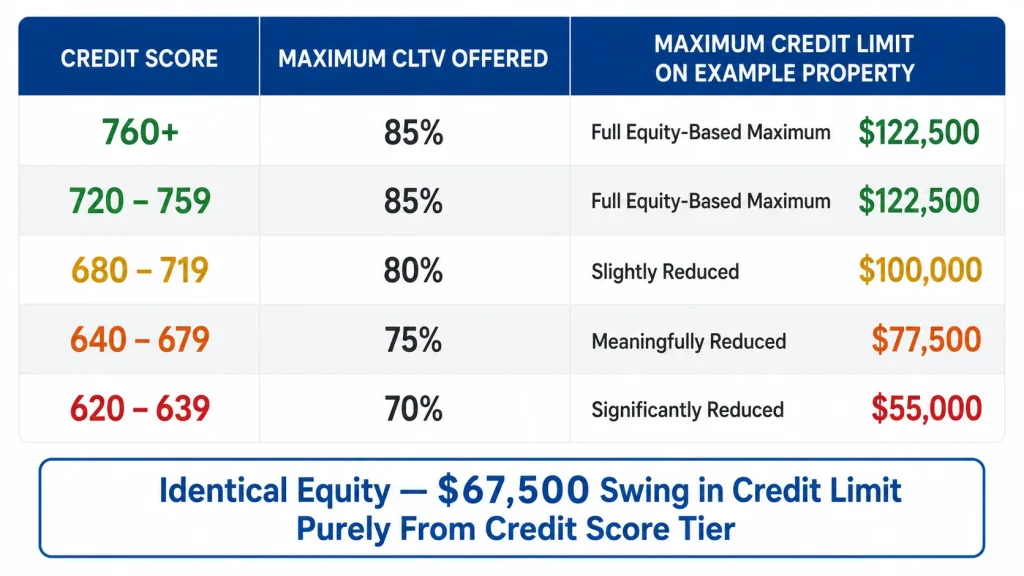
| Credit Score | Maximum CLTV Offered | Maximum Credit Limit |
|---|---|---|
| 760+ | 85% | Full equity-based maximum |
| 720–759 | 85% | Full equity-based maximum |
| 680–719 | 80% | Slightly reduced |
| 640–679 | 75% | Meaningfully reduced |
| 620–639 | 70% | Significantly reduced |
A borrower with a 650 credit score and the same $450,000 home and $260,000 mortgage as our earlier example might only be offered a 75% CLTV instead of 85% — reducing their maximum from $122,500 to:
$450,000 × 75% = $337,500 − $260,000 = $77,500
That’s a $45,000 reduction in available credit purely from the credit score tier, with identical equity.
Factor 5: Property Type and Occupancy
The credit limit formula assumes a primary residence in most examples, but lenders apply different — generally more conservative — CLTV maximums for other property types.
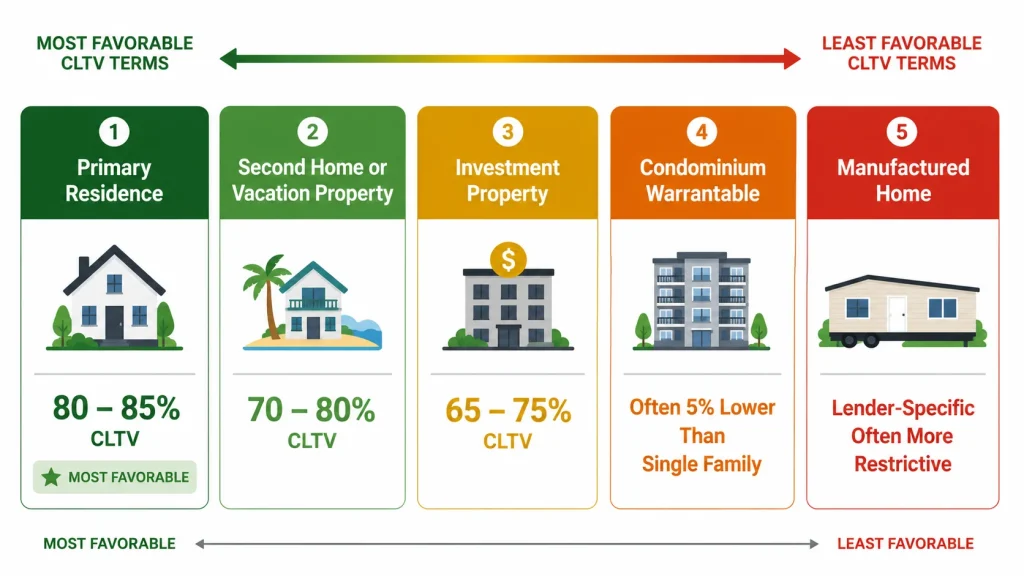
| Property Type | Typical Maximum CLTV |
|---|---|
| Primary residence | 80–85% |
| Second home / vacation property | 70–80% |
| Investment property (non-owner-occupied) | 65–75% |
| Condominium (warrantable) | Often 5% lower than single-family max |
| Manufactured home | Lender-specific, often more restrictive |
If you’re seeking a HELOC on a rental property rather than your primary residence, expect a meaningfully lower maximum CLTV — and therefore a lower credit limit — than the same equity position would support on a primary residence.
Factor 6: Lien Position and Existing Debt Structure
The formula accounts for your existing mortgage balance, but it’s worth understanding why this specific number matters so much. The lender extending the HELOC is taking a second lien position — meaning if you default and the home is foreclosed, your first mortgage lender gets paid first from the sale proceeds, and the HELOC lender only recovers what’s left.
This is precisely why the formula subtracts your existing mortgage balance rather than just looking at your home’s total value. A home worth $450,000 with no mortgage at all supports a much larger HELOC than the same home with a $400,000 mortgage already in place — even though the home’s value is identical in both cases.
If you have any other liens on the property — a second mortgage, a judgment lien, a contractor’s lien — those also get subtracted from the available equity calculation, further reducing your HELOC credit limit.
A Complete Worked Example: How All Six Factors Combine
Let’s walk through a full example where multiple factors interact.
Property and borrower profile:
- Appraised home value: $520,000
- Existing mortgage balance: $310,000
- Property type: Primary residence
- Credit score: 705
- Gross monthly income: $9,500
- Existing monthly debts: $1,400
Step 1: Calculate the equity-based maximum at this lender’s standard CLTV for a 705 credit score (let’s say 82%):
$520,000 × 82% = $426,400 $426,400 − $310,000 = $116,400 equity-based maximum
Step 2: Check DTI capacity at 43%:
$9,500 × 0.43 = $4,085 maximum total monthly debt $4,085 − $1,400 existing debts = $2,685 available for new HELOC payment
Step 3: Convert available payment capacity to a supportable balance (interest-only minimum at, say, 8.75%):
$2,685 ÷ (8.75% ÷ 12) = approximately $368,200
In this case, the income-based capacity ($368,200) far exceeds the equity-based maximum ($116,400) — meaning equity is the binding constraint, not income. The lender would likely approve a credit limit at or near the full $116,400 equity-based maximum, since the borrower’s income comfortably supports it.
This example illustrates an important point: for many borrowers with solid income relative to their mortgage, equity is the binding constraint on credit limit, not income. For borrowers with large existing debts relative to income, the reverse can be true — income becomes the binding constraint even when equity would support more.
How to Estimate Your Own Credit Limit Before Applying
You can run a reasonable estimate yourself before formally applying:
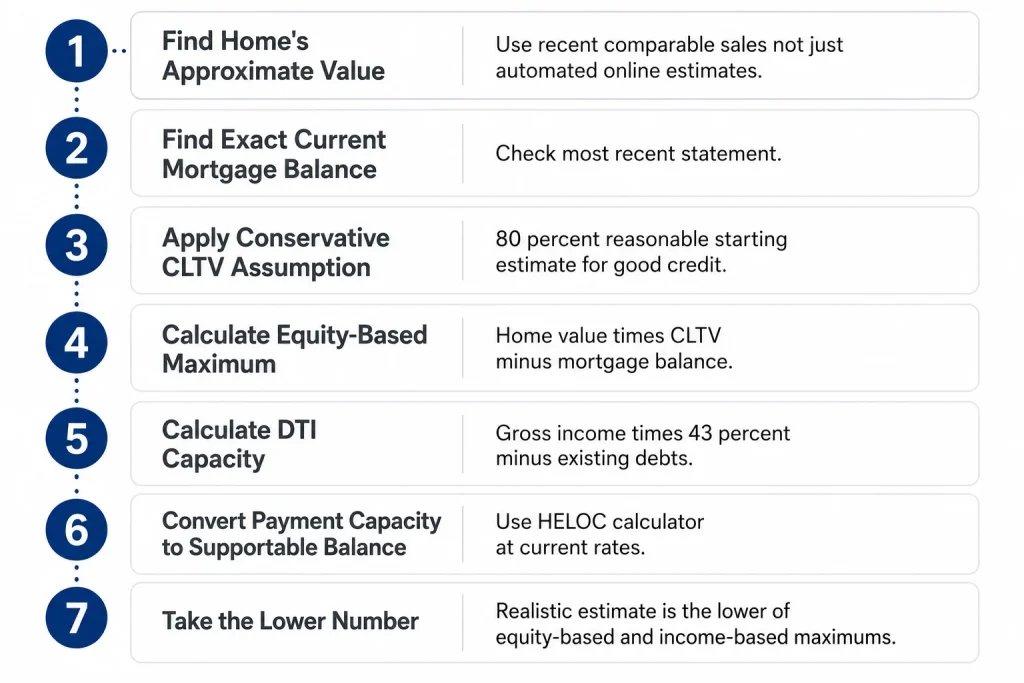
Step 1: Find your home’s approximate current value using recent comparable sales in your neighborhood (not just an automated online estimate, which can be off by 5–10% or more).
Step 2: Find your exact current mortgage balance from your most recent statement.
Step 3: Apply a conservative CLTV assumption — 80% is a reasonable starting estimate for most borrowers with good credit on a primary residence.
Step 4: Calculate: (Home Value × 80%) − Mortgage Balance = estimated equity-based maximum.
Step 5: Calculate your DTI capacity: (Gross Monthly Income × 0.43) − Existing Monthly Debts = available payment capacity.
Step 6: Convert that payment capacity to an estimated supportable balance using current rates in our HELOC Payment Calculator.
Step 7: Your realistic estimated credit limit is the lower of the equity-based maximum (Step 4) and the income-supported maximum (Step 6).
This won’t be exact — actual underwriting involves additional details — but it gives you a realistic range before you spend time on a formal application.
What to Do If Your Offered Credit Limit Is Lower Than Expected
If a lender offers you a credit limit below what you calculated, a few things are worth checking:
Ask which factor was binding. Was it the appraisal coming in lower than expected, a lower CLTV tier due to credit score, or DTI capacity? Lenders will generally tell you if you ask directly, and the answer tells you what — if anything — is fixable.
Get a second opinion from another lender. Different lenders use different CLTV maximums and different appraisal methods. A lender using an AVM that came in low might be worth comparing against one that uses a full appraisal, or vice versa.
Pay down other debts before reapplying. If DTI was the binding constraint, reducing other monthly obligations — paying off a car loan, paying down credit cards — directly increases your available capacity for a HELOC payment.
Wait for credit improvement. If a lower CLTV tier due to credit score was the limiting factor, the math in this article shows how much that single variable affects your outcome. A focused effort to raise your score before applying can unlock a meaningfully higher limit.
Consider whether you need the full theoretical maximum. Sometimes a lower offered limit is simply a more conservative number than your absolute ceiling — and still more than enough for your actual borrowing need.
The Bottom Line
Your HELOC credit limit isn’t a single simple calculation — it’s the intersection of your home’s appraised value, your lender’s risk-based CLTV tier for your credit profile, your existing mortgage balance, your property type, and your income’s capacity to support the resulting payment. Equity sets the ceiling; income and credit score determine how much of that ceiling you actually get offered.
Understanding all the moving pieces means you can estimate your realistic credit limit before applying, recognize which specific factor is limiting you if an offer comes in lower than expected, and know exactly what to address — paying down debt, improving credit, or shopping a lender with a higher CLTV tier — to access more of your home’s equity.
Use our HELOC Payment Calculator to model what payment a given credit limit would actually produce, so you can sanity-check any number a lender offers against your own budget.