HELOC Variable Rates: How Prime Rate Affects Your Payment
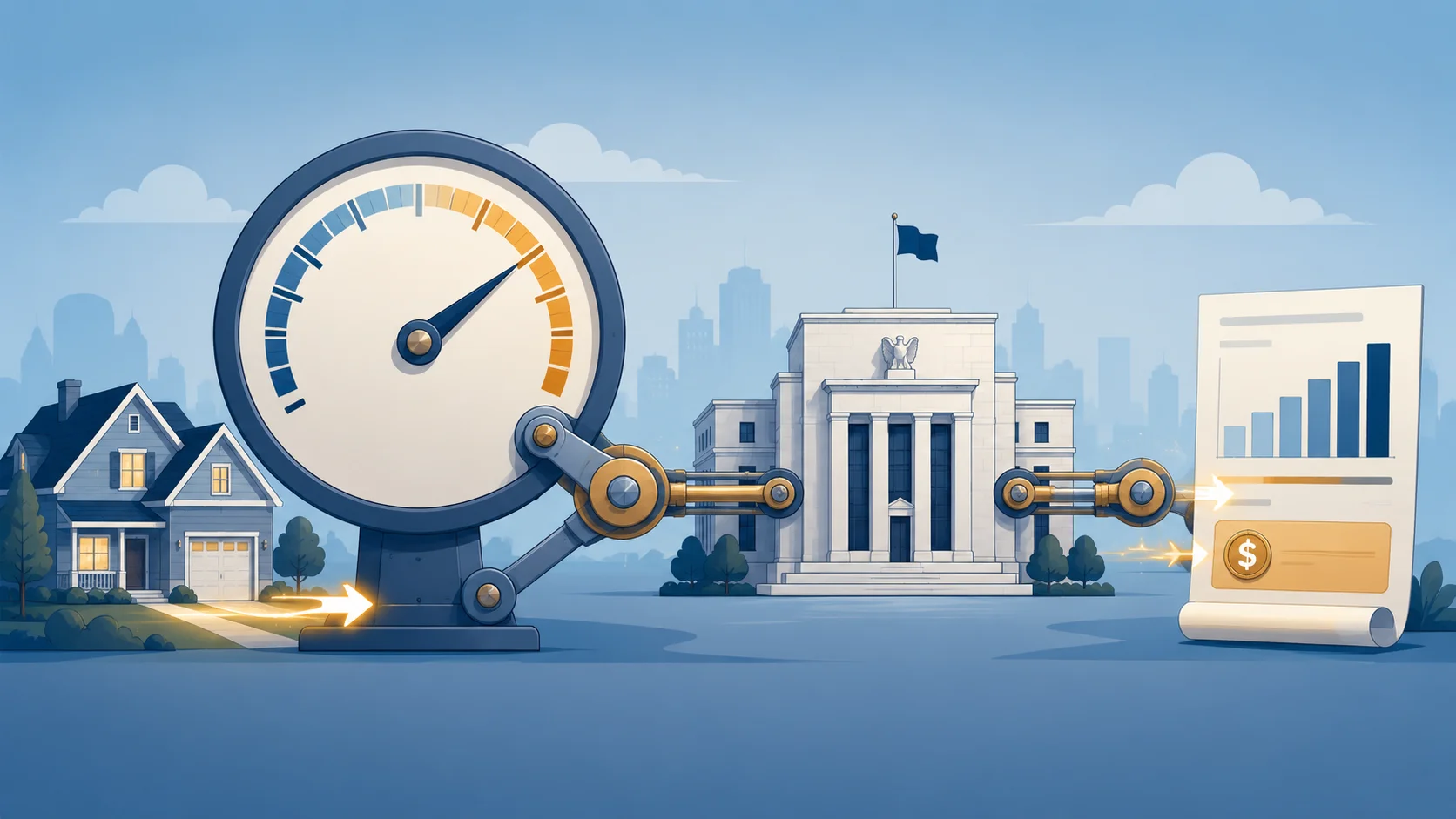
If you have a HELOC, your interest rate is not something you locked in at closing and can forget about. It moves — sometimes several times a year — and it moves because of decisions made by the Federal Reserve that have nothing directly to do with you, your home, or your lender. Understanding the mechanism connecting Fed policy to your monthly payment is the difference between being caught off guard by a statement and seeing a rate change coming months in advance.
This article explains exactly how the prime rate works, how your specific HELOC rate is built from it, and what realistic rate movements actually do to your payment in dollar terms.
The Two-Part Structure of Every HELOC Rate
Your HELOC interest rate is built from two components:
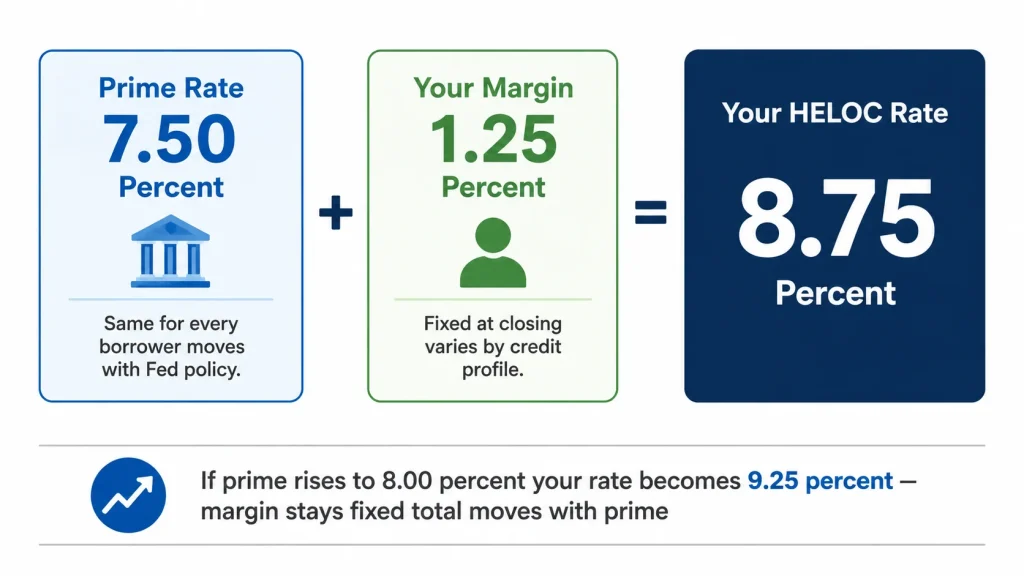
HELOC Rate = Prime Rate + Margin
The prime rate is a benchmark interest rate that moves in response to the Federal Reserve’s federal funds rate. It’s published by the Wall Street Journal and widely used across the lending industry as a reference point — hence the common name “Wall Street Journal Prime Rate.”
The margin is a fixed percentage your specific lender adds on top of the prime rate, based on your credit profile, your CLTV, and the lender’s own pricing. The margin is set at closing and generally does not change for the life of the loan (unless your agreement specifically allows for adjustment, which is uncommon).
Example:
Prime rate: 7.50% Your margin: 1.25% Your HELOC rate: 8.75%
If the prime rate rises to 8.00%, your rate becomes 9.25% — the margin stays fixed at 1.25%, but the total moves with the prime rate.
How the Prime Rate Actually Moves
The prime rate doesn’t move on its own schedule. It moves in direct response to changes in the federal funds rate, which the Federal Reserve’s Federal Open Market Committee (FOMC) sets at scheduled meetings roughly eight times a year.

The mechanical relationship:
Prime Rate = Federal Funds Rate + 3.00% (this 3% spread has remained remarkably consistent for decades)
When the Fed raises the federal funds rate by 0.25%, the prime rate typically rises by the same 0.25% within a day or two — banks adjust it almost immediately following a Fed announcement. When the Fed cuts rates, the prime rate drops correspondingly.
Important nuance: the Fed does not set HELOC rates directly, and it doesn’t even set the prime rate directly — the prime rate is technically set by individual banks, but in practice, virtually all major banks move it in lockstep with the Fed’s federal funds rate target, making it function as a single, predictable benchmark across the industry.
Your Margin: What Determines It and Why It Varies
While the prime rate is identical for every borrower at every lender, the margin is specific to you — and this is where most of the variation in actual HELOC rates between borrowers comes from.
Factors that influence your margin:
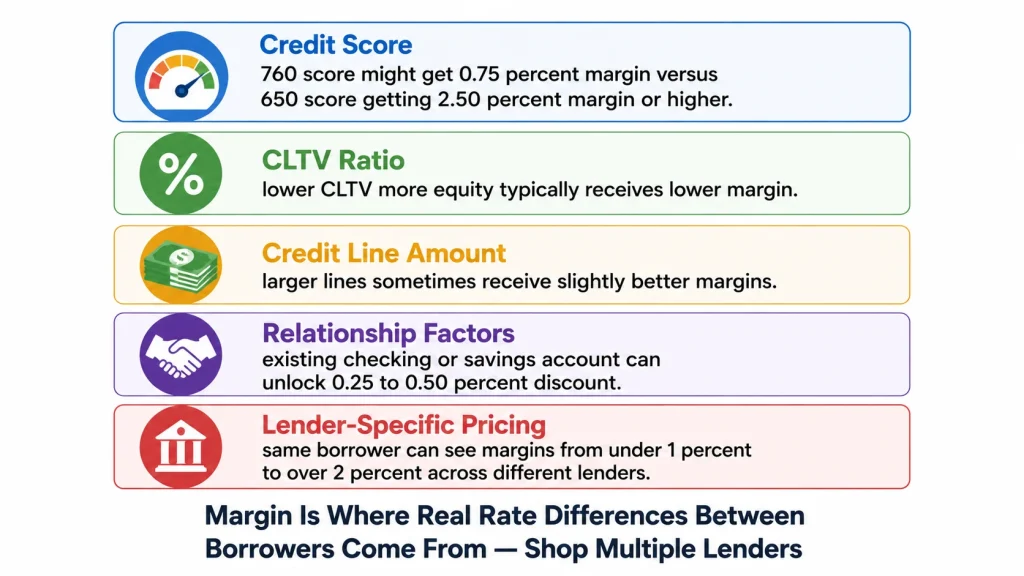
Credit score. Higher scores generally receive lower margins. A borrower with a 760 score might receive a 0.75% margin, while a borrower with a 650 score at the same lender might receive a 2.50% margin or higher — a 1.75 percentage point difference that compounds significantly over the life of a HELOC.
CLTV ratio. Borrowers with more equity (lower CLTV) typically receive lower margins than borrowers near the lender’s maximum CLTV threshold, since the lender’s risk exposure is lower.
Credit line amount. Some lenders offer slightly better margins for larger credit lines, since the fixed costs of originating and servicing the loan are spread over a larger balance.
Relationship factors. Many lenders offer a margin discount — often 0.25% to 0.50% — for borrowers who maintain a checking or savings account with them and/or set up automatic payments from that account.
Lender-specific pricing. Different lenders simply price risk differently. The same borrower profile can receive margins ranging from under 1% to over 2% depending entirely on which institution they apply with — which is exactly why shopping multiple lenders, as covered in our lender comparison guide, produces real savings.
What a Rate Change Actually Does to Your Payment
The practical question every HELOC borrower eventually asks: when the rate moves, how much does my payment actually change?
The answer depends on which phase of the HELOC you’re in.
During the Draw Period (Interest-Only Payments)
Since the minimum payment during the draw period is calculated as Balance × (Rate ÷ 12), a rate change produces a direct, proportional change to your payment.
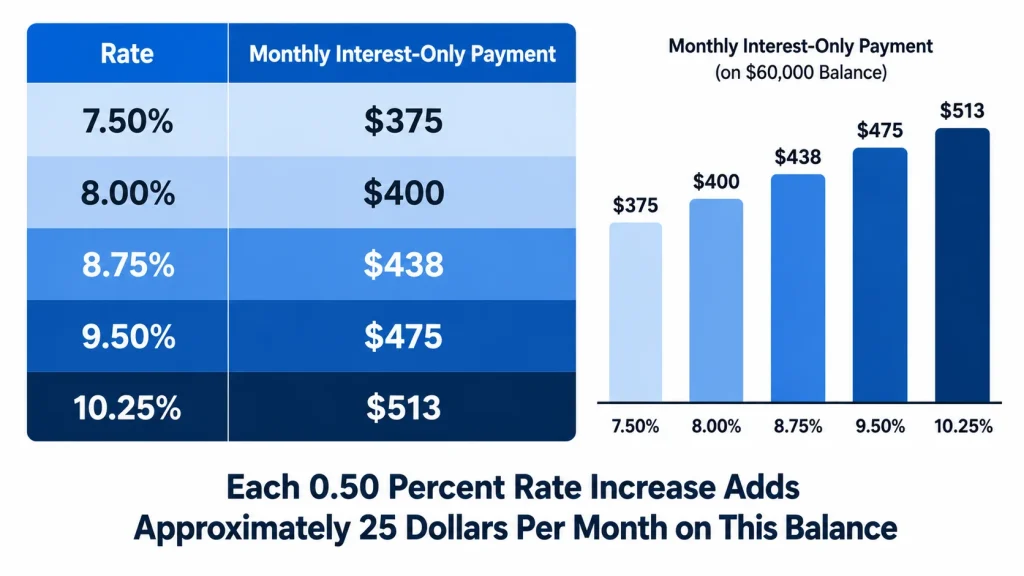
Example: $60,000 balance
| Rate | Monthly Interest-Only Payment |
|---|---|
| 7.50% | $375 |
| 8.00% | $400 |
| 8.75% | $438 |
| 9.50% | $475 |
| 10.25% | $513 |
A 0.50% rate increase on this balance adds $25/month. A full 1.00% increase adds about $50/month. These changes are immediate and recalculated the moment the new rate takes effect.
During the Repayment Period (Fully Amortized Payments)
The relationship is more complex here because the payment is calculated to fully pay off the balance over a fixed remaining term — meaning a rate change affects not just the interest portion but recalculates the entire payment.
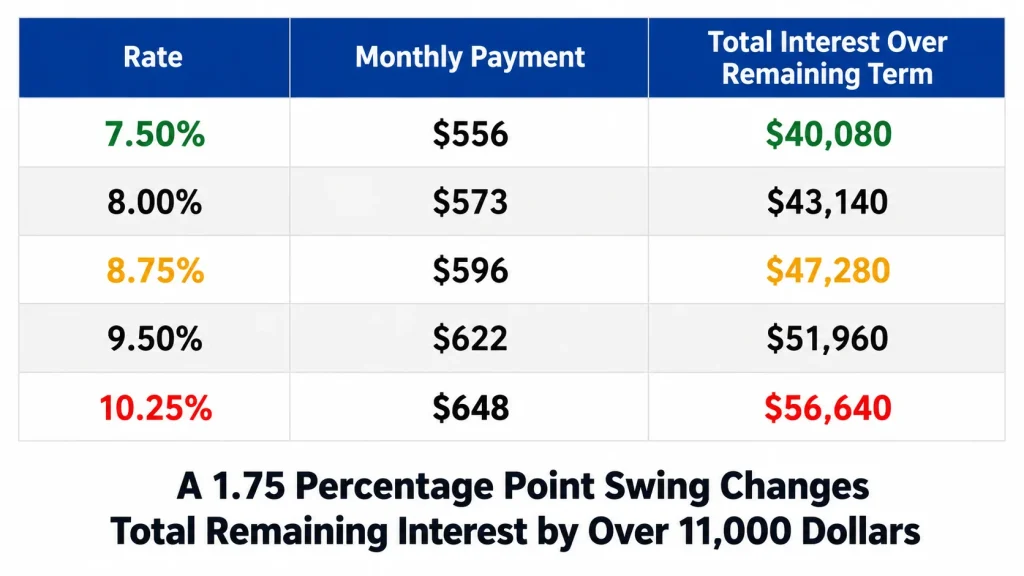
Example: $60,000 balance, 15 years remaining in repayment
| Rate | Monthly Payment | Total Interest Over Remaining Term |
|---|---|---|
| 7.50% | $556 | $40,080 |
| 8.00% | $573 | $43,140 |
| 8.75% | $596 | $47,280 |
| 9.50% | $622 | $51,960 |
| 10.25% | $648 | $56,640 |
Notice that the payment changes are smaller in percentage terms than during the draw period, but the total interest impact over the remaining term is substantial — a 1.75 percentage point swing (from 7.50% to 9.25%) changes total remaining interest by over $11,000 on this balance.
Important practical note: lenders handle repayment-period rate changes differently. Some recalculate your monthly payment to keep your original payoff date fixed (so the payment goes up or down with rate changes, but you still finish paying in the same year). Others keep your payment fixed and extend or shorten the payoff date instead. Check your specific loan agreement — this materially changes what you should expect when rates move during repayment.
How Often Does Your Rate Actually Change?
Your rate changes whenever the prime rate changes — which depends entirely on Federal Reserve policy, not a schedule built into your HELOC agreement.
In periods of active Fed policy adjustment (like 2022–2023, when the Fed raised rates rapidly to combat inflation), HELOC borrowers saw their rates change multiple times within a single year — sometimes at every one of the eight scheduled FOMC meetings. In calmer periods, the rate might stay flat for a year or more if the Fed holds rates steady.
Your specific HELOC agreement specifies exactly when a prime rate change takes effect on your account — commonly either immediately, or on the first day of your next billing cycle following the change. This timing detail is in your original loan documents.
A Real Multi-Year Scenario: Tracking Rate Changes Over Time
To make this concrete, here’s a hypothetical (but realistic) sequence showing how a HELOC payment might evolve over several years as the prime rate moves, on a steady $50,000 balance during the draw period with a 1.25% margin.
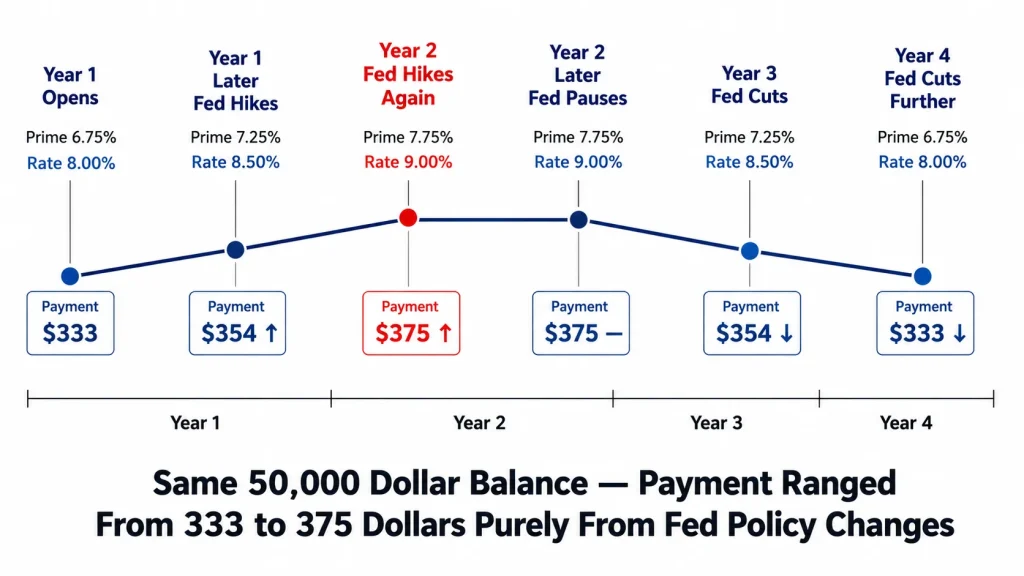
| Period | Prime Rate | Your HELOC Rate | Monthly Payment |
|---|---|---|---|
| Year 1 (HELOC opens) | 6.75% | 8.00% | $333 |
| Year 1, later (Fed hikes) | 7.25% | 8.50% | $354 |
| Year 2 (Fed hikes again) | 7.75% | 9.00% | $375 |
| Year 2, later (Fed pauses) | 7.75% | 9.00% | $375 |
| Year 3 (Fed begins cutting) | 7.25% | 8.50% | $354 |
| Year 4 (Fed cuts further) | 6.75% | 8.00% | $333 |
Over this hypothetical four-year stretch, the monthly payment on an identical $50,000 balance ranged from $333 to $375 — a $42/month swing — purely from Fed policy changes, with no change in the borrower’s own balance or credit profile. This is the lived reality of holding variable-rate debt over a multi-year period: the payment is a moving target, not a fixed number.
Rate Caps: Some Protection, Not Universal
Some — though not all — HELOC lenders offer rate caps that limit how much your rate can move.
Periodic caps limit how much the rate can increase within a specific period, such as a single year, regardless of how much the prime rate moves.
Lifetime caps limit the maximum rate the HELOC can ever reach over its entire term, regardless of how high the prime rate goes.
Rate caps are not standard on every HELOC product — many lenders offer HELOCs with no caps at all, meaning your rate moves exactly in step with the prime rate with no ceiling. If rate volatility is a significant concern for your financial planning, specifically ask each lender you’re considering whether caps are available and what they cost (caps sometimes come with a slightly higher starting margin in exchange for the protection).
The Fixed-Rate Conversion Option
A number of lenders allow you to convert all or a portion of your outstanding HELOC balance to a fixed rate at some point during the loan — effectively creating a fixed-rate sub-loan within your HELOC.
This feature, where available, lets you eliminate variable rate exposure on the portion you convert while keeping the rest of your credit line variable and flexible. It’s particularly useful if you’ve drawn a large balance for a specific purpose (like a renovation) and want payment certainty on that amount, while still keeping some undrawn credit available for future flexible use.
Not every lender offers this. Ask specifically if rate stability matters to you — it’s a meaningful differentiator when shopping lenders.
How to Track the Prime Rate Yourself
You don’t need to wait for your monthly statement to know whether your rate has changed. The prime rate is public information, updated and published whenever it changes.
You can check the current Wall Street Journal Prime Rate through financial news sources, the Federal Reserve’s own published data releases, or simply by searching for it online — it’s widely reported every time it changes following a Fed announcement.
Once you know your specific margin (stated in your loan agreement), you can calculate your current rate at any time:
Your Current Rate = Current Prime Rate + Your Fixed Margin
This lets you anticipate a statement change before it arrives, rather than being surprised by it.
Practical Steps for Managing Variable Rate Exposure
Know your margin. This number is fixed for the life of your loan and is in your original loan agreement. Once you know it, you can always calculate your current rate from the published prime rate.
Check the prime rate after every FOMC meeting. The Fed announces rate decisions roughly eight times a year. A quick check after each announcement tells you whether your rate is about to change.
Build a rate-increase buffer into your budget. If your draw period payment is comfortable at the current rate, stress-test your budget against a 1–2 percentage point increase to confirm you could absorb it without difficulty.
Pay down principal more aggressively in a rising-rate environment. Since your interest cost scales directly with your balance, reducing the balance reduces your exposure to future rate increases — every dollar of principal paid off is a dollar no longer subject to rate risk.
Ask about caps and fixed-rate conversion before you open the HELOC. These features, where available, are far easier to secure at origination than to add after the fact.
The Bottom Line
Your HELOC rate is built from two parts: the prime rate, which moves with Federal Reserve policy and is identical for every borrower, and your margin, which is fixed at closing and reflects your specific credit profile and lender’s pricing. When the Fed moves rates, your prime-rate-linked HELOC rate follows within days, and your payment recalculates accordingly — proportionally during the draw period, and through a full re-amortization during the repayment period.
This isn’t unpredictable in principle — it’s directly tied to public Fed policy decisions you can track in advance — but it does mean your HELOC payment is genuinely a moving number over the life of the loan, not a fixed one. Planning for that reality, rather than assuming your opening rate is permanent, is what separates borrowers who handle rate changes smoothly from those who experience every Fed announcement as a fresh surprise.
Use our HELOC Payment Calculator to model how different rate scenarios would affect your specific balance and payment — both now and under a range of future rate environments.