What Happens When Your HELOC Draw Period Ends?
Somewhere in your original HELOC paperwork is a specific date — often years in the future when you signed — marking the end of your draw period. For many borrowers, that date arrives quietly, mentioned briefly in a statement months in advance, and then suddenly it’s the actual transition month and the payment on the bill looks different than every payment before it.
This article walks through exactly what happens on and around that date — mechanically, procedurally, and financially — along with the choices you have in the months leading up to it and what to actually do once it arrives.
The Date Itself: What Triggers the Transition
Your draw period end date isn’t determined by your balance, your behavior, or anything you do — it’s a fixed calendar date specified in your original HELOC agreement, typically calculated as a set number of years (commonly 10, sometimes 5) from the date your HELOC was opened.
This date doesn’t move. It doesn’t matter whether you’ve drawn the full credit limit or barely touched it, whether you’ve been paying extra or only the minimum, or whether your financial situation has changed since you opened the account. Unless you take specific action beforehand (covered below), the transition happens automatically on the scheduled date.
Where to find your exact date: Check your original HELOC agreement (the document you signed at closing) or your most recent monthly statement, which typically displays the draw period end date prominently as the transition approaches. If you can’t locate it, a call to your lender will get you the exact date immediately.
What Changes the Moment the Draw Period Ends
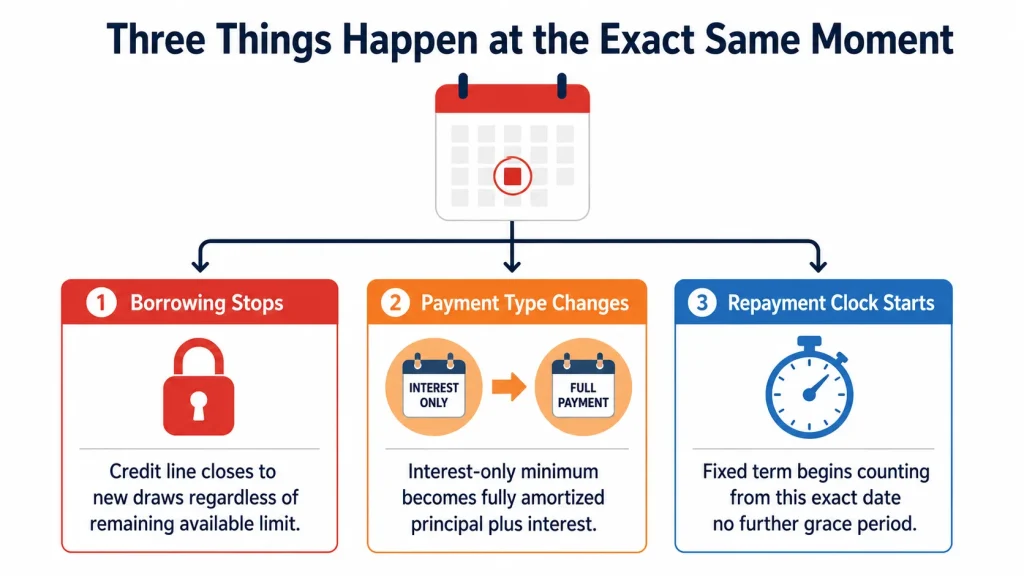
Three specific things happen simultaneously on the transition date.
1. Your Ability to Borrow Stops
The credit line closes to new draws. You can no longer access additional funds, write HELOC checks, or initiate transfers — regardless of how much available credit remained on your limit. If you had $40,000 of undrawn credit available the day before, that access disappears the day the draw period ends.
This is worth planning around specifically: if you anticipate needing additional funds for an ongoing project, the window to draw them closes permanently on this date, not gradually.
2. Your Payment Type Changes From Interest-Only to Fully Amortized
This is the change most borrowers feel directly. Instead of a minimum payment that only covers that month’s interest, your new minimum payment is calculated to pay off your entire remaining balance — principal and interest — by the end of your repayment term (commonly 10, 15, or 20 years from this date).
The new payment is calculated using your balance at the moment the draw period ends, your current interest rate, and your remaining repayment term, using the standard amortization formula. On a typical $50,000–$75,000 balance, this transition produces a payment increase in the range of 30–40%, though the exact figure depends entirely on your specific numbers.
3. The Repayment Clock Starts
Your repayment term — the fixed number of years you have to pay off the remaining balance — begins counting from this exact date. Whatever balance exists on the transition date is the balance that gets amortized over the repayment term; there’s no further grace period or adjustment window once repayment begins.
What Does NOT Change
It’s worth being equally clear about what stays the same, since some borrowers expect more disruption than actually occurs.
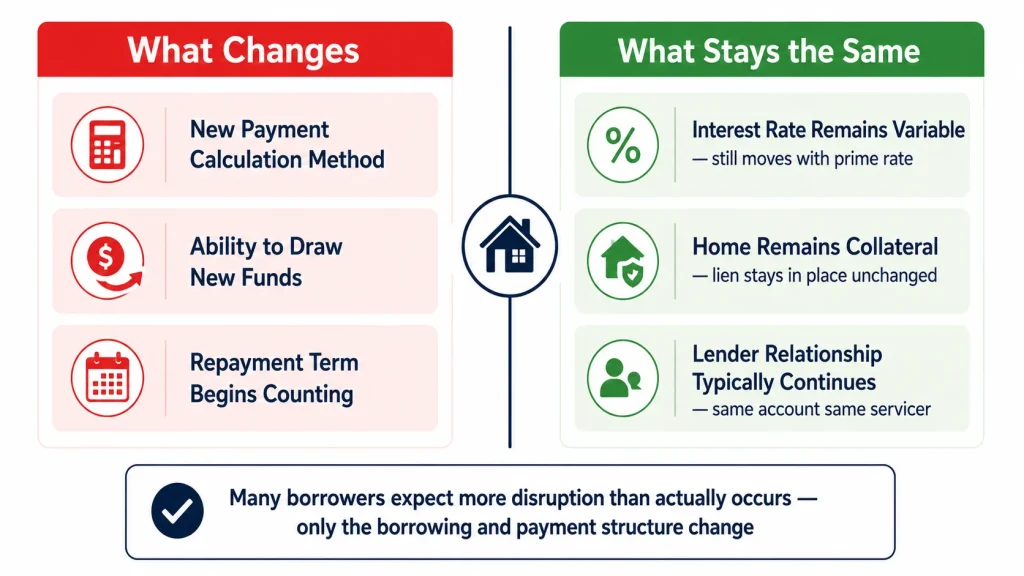
Your interest rate structure stays variable. The transition to repayment doesn’t convert your HELOC to a fixed rate. Your rate continues to move with the prime rate throughout the repayment period, just as it did during the draw period — meaning your payment can still change if rates move, even though you’re no longer drawing funds.
The lien on your home remains in place. Your home continues to secure the debt exactly as before. Nothing changes about the collateral arrangement.
Your account number and lender relationship typically stay the same. Unless you specifically refinance or the loan is sold to another servicer (which can happen independently of the draw period transition, just as with any loan), you’ll continue making payments to the same institution through the same account.
When Your Lender Notifies You — and Why It’s Not Enough
Federal regulations require lenders to send notice of the upcoming draw period expiration, but the specifics of timing and content vary by lender, and the notification is often less prominent than the magnitude of the change deserves.
Many lenders send a notice approximately 6 months before the draw period ends, and some include a reminder in monthly statements during the final year. But these notices typically arrive as a paragraph within a larger statement — easy to skim past if you’re not specifically looking for it.
The practical lesson: don’t rely on your lender’s notification as your primary planning trigger. Mark the date yourself, in your own calendar, with enough lead time to actually act on the information — ideally 12 to 18 months before the transition, not 6.
Your Options in the 12–24 Months Before the Transition
This is the window where you actually have choices. Once the transition date passes, your options narrow considerably. Here’s what’s available while you still have time.
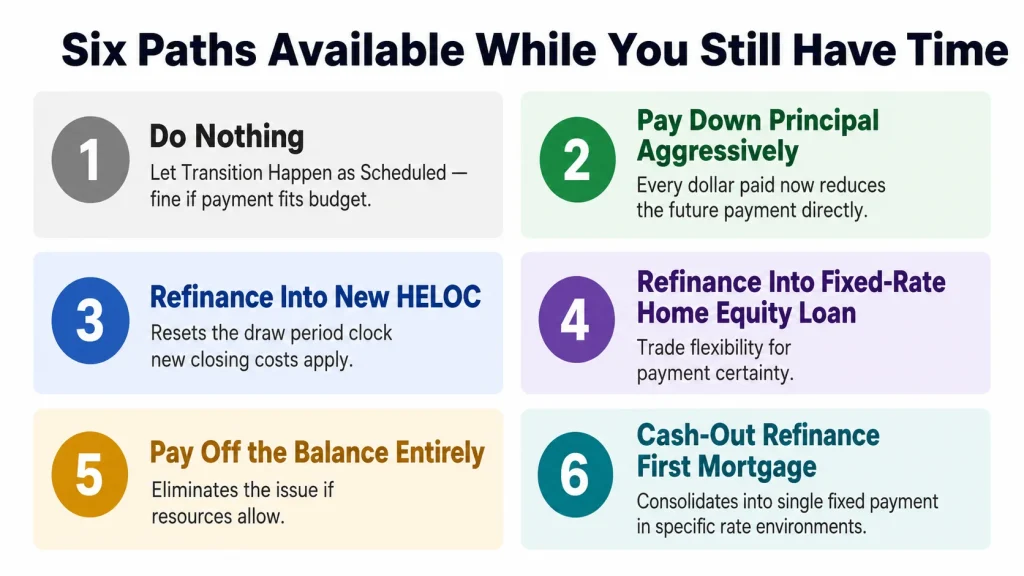
Option 1: Do Nothing and Let the Transition Happen as Scheduled
For many borrowers, this is genuinely the right choice — particularly if you’ve calculated the new payment in advance and confirmed it fits comfortably within your budget. There’s nothing inherently wrong with a HELOC transitioning to repayment on schedule; that’s how the product is designed to work.
Option 2: Pay Down Principal Aggressively Before the Transition
Every dollar of principal you pay off before the draw period ends is a dollar that won’t be part of the balance that gets amortized into your new payment. This is the most direct way to reduce the size of the payment increase.
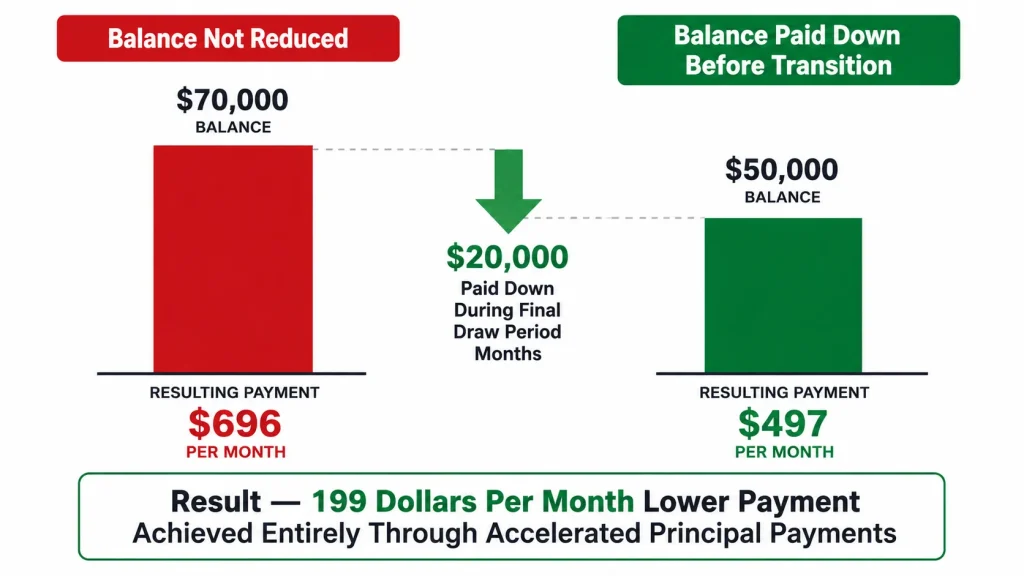
Example: A $70,000 balance entering a 15-year repayment at 8.75% produces a payment of approximately $696/month. If you pay that balance down to $50,000 before the transition, the same repayment term produces a payment of approximately $497/month — a $199/month difference, achieved entirely by accelerating principal payments during the months you still have draw-period flexibility.
Option 3: Refinance Into a New HELOC
Some lenders will allow you to refinance an existing HELOC — paying off the current one and opening a new one, effectively resetting the draw period clock. This isn’t free (expect new closing costs, and you’ll need to qualify again based on your current credit, income, and equity), and it delays rather than eliminates the eventual need to repay the balance. But if your circumstances have changed — you need continued flexible access, or you simply aren’t ready for the repayment structure yet — this is worth exploring with your current lender or a new one.
Option 4: Refinance Into a Home Equity Loan or Fixed-Rate Product
If your priority is converting from variable-rate uncertainty to payment predictability, refinancing your HELOC balance into a fixed-rate home equity loan accomplishes that. You’ll know your exact payment for the entire remaining term, with no further rate exposure. The tradeoff is giving up any benefit from future rate decreases, and incurring whatever closing costs apply to the new loan.
Option 5: Pay Off the Balance Entirely
If you have the resources — savings, an investment account, proceeds from another source — paying off the HELOC balance entirely before the transition eliminates the issue altogether. Whether this is the right financial move depends on what else that money could be doing for you; see our article on HELOC Early Payoff for the full decision framework.
Option 6: Consider a Cash-Out Refinance of Your First Mortgage
In specific circumstances — particularly if your first mortgage rate is no longer significantly below current market rates — rolling your HELOC balance into a cash-out refinance of your primary mortgage consolidates both debts into a single fixed-rate payment. This involves more significant closing costs than the other options and only makes sense in particular rate environments; it’s covered in detail in our HELOC vs. Cash-Out Refinance comparison.
What If You’re Already Past the Transition and Struggling?
If the draw period has already ended and the new payment is creating genuine financial strain, you still have options — though they require proactive outreach rather than passive waiting.
Contact your lender directly and ask about modification options. Many lenders have hardship or modification programs that can adjust your repayment term, temporarily reduce payments, or restructure the loan — but these are rarely advertised and almost always require you to initiate the conversation.
Explore refinancing even after the transition. The refinance options described above (new HELOC, fixed-rate home equity loan, cash-out refinance) remain available after the transition, not just before it — though acting sooner generally preserves more options and avoids any payment difficulty compounding.
Do not simply stop paying or pay less than the required amount without communicating with your lender first. Missed or partial payments trigger late fees, credit damage, and — since your home secures this debt — eventually more serious consequences. If you’re struggling, the lender conversation should happen before a missed payment, not after.
A Practical Timeline for Preparing
Here’s a realistic preparation sequence, working backward from your draw period end date.
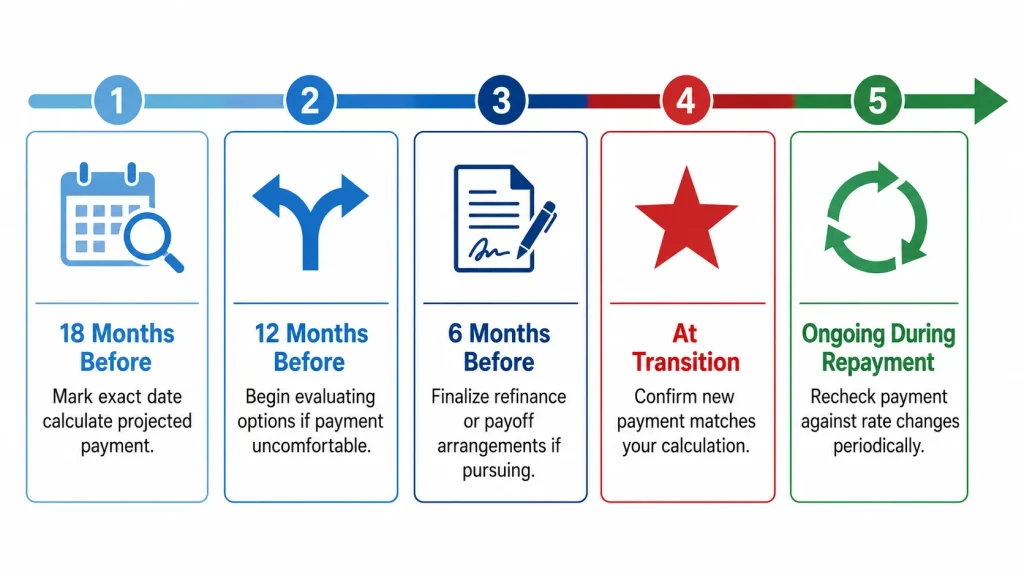
18 months before: Mark the exact date. Calculate your projected repayment payment using your current balance and rate in our HELOC Payment Calculator. Confirm whether it fits your budget.
12 months before: If the projected payment is uncomfortable, begin evaluating your options — accelerated principal payments, refinancing, or payoff — and start whichever path makes sense. Refinancing in particular benefits from lead time, since the application and underwriting process takes weeks.
6 months before: If you’re pursuing a refinance or payoff strategy, this is typically when you’d be finalizing those arrangements so they complete before the transition date arrives.
At the transition: Confirm your new payment amount on your first post-transition statement matches what you calculated. If it doesn’t, contact your lender to understand the discrepancy — it could reflect a rate change, a different repayment term than you assumed, or a calculation error worth catching early.
Ongoing during repayment: Since your rate remains variable, periodically recheck your payment against current rates, particularly after Federal Reserve policy announcements, so changes during repayment don’t catch you off guard either.
The Bottom Line
The end of your draw period is not a surprise event — it’s a scheduled, predictable date that exists in your loan documents from the day you opened the HELOC. The transition itself involves three specific changes: borrowing stops, your payment converts from interest-only to fully amortized, and your repayment clock begins. Everything else about the loan — the variable rate, the collateral, typically the lender relationship — continues as before.
The real determinant of whether this transition feels manageable or alarming is almost entirely about preparation timing. Borrowers who know their date, calculate their new payment well in advance, and act on that information — whether that means paying down principal, refinancing, or simply confirming the new payment fits their budget — experience this as a planned transition. Borrowers who don’t look until the new statement arrives experience it as a shock.
Use our HELOC Payment Calculator right now, regardless of how far away your transition date is, to see exactly what your repayment payment will look like — so there’s no version of this event you haven’t already seen coming.