HELOC Pros and Cons: Is It Right for You? (2026)
By now, if you’ve read through enough of the home equity borrowing landscape, you’ve encountered both the enthusiastic case for a HELOC and the cautionary one. Both are correct, depending on who’s holding the credit line. A HELOC is neither a financial trap nor a free source of money — it’s a tool, and like any tool, its value depends entirely on whether it fits the job in front of you.
This article pulls the full picture together: every genuine advantage, every real risk, and a practical way to weigh them against your specific situation rather than a generic recommendation that doesn’t account for the details that actually matter.
The Pros: What a HELOC Genuinely Does Well
Lower Interest Rates Than Most Unsecured Borrowing
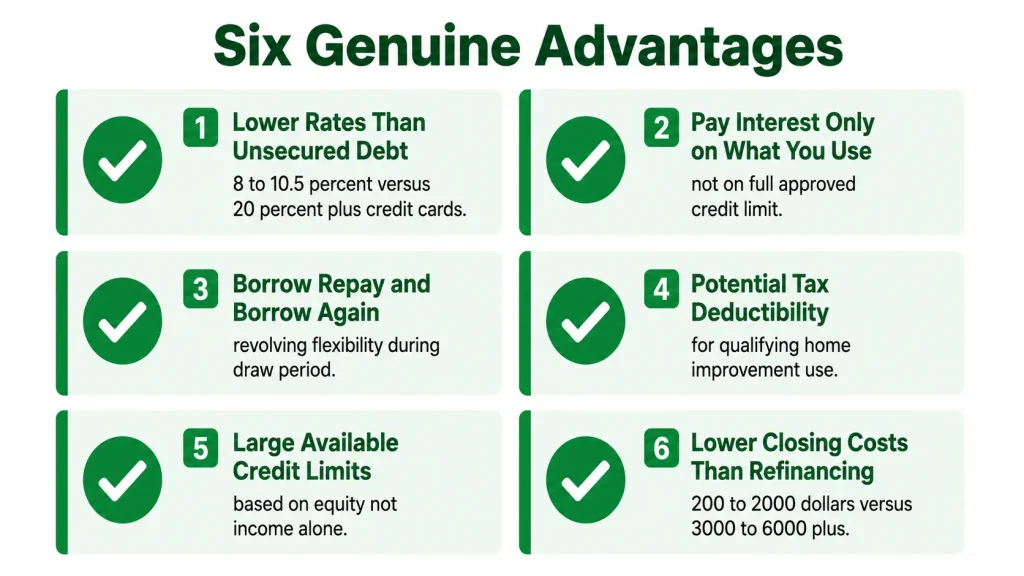
Because a HELOC is secured by your home, lenders price the risk lower than they would for unsecured debt. In 2026, HELOC rates typically run 8% to 10.5% for well-qualified borrowers — compared to 20%+ for credit cards and often 12% to 19% for personal loans. On meaningful balances, this rate gap translates into thousands of dollars in interest savings, sometimes tens of thousands on larger amounts carried for several years. We’ve broken this down in detail in our HELOC vs. Credit Card comparison.
You Only Pay Interest on What You Actually Use
Unlike a lump-sum loan, a HELOC charges interest only on your drawn balance — not your full approved credit limit. If you’re approved for $100,000 but have only drawn $30,000, you’re paying interest on $30,000. This matters enormously for staged expenses like home renovations, where costs arrive over months rather than all at once.
Flexibility to Borrow, Repay, and Borrow Again
During the draw period, a HELOC functions like a revolving credit line. You can draw funds, pay them down, and draw again as needs arise — without reapplying or going through underwriting each time. This is genuinely useful for ongoing or unpredictable expenses where a one-time loan doesn’t match the actual spending pattern.
Potential Tax Deductibility
When HELOC funds are used to buy, build, or substantially improve the home securing the loan, the interest may be tax deductible — something no credit card or personal loan interest ever qualifies for. As covered in our tax deductibility guide, this benefit depends on your specific use of funds and whether you itemize deductions, but for qualifying borrowers it meaningfully reduces the effective cost of borrowing.
Large Available Credit Limits
Because the credit limit is based on your home equity rather than your income alone, HELOCs can offer substantially larger credit lines than unsecured products — sometimes well into six figures for homeowners with significant equity. This makes a HELOC one of the few realistic tools for funding genuinely large expenses at a reasonable rate.
Lower Closing Costs Than Refinancing Alternatives
Compared to a cash-out refinance, which typically runs $3,000 to $6,000+ in closing costs, a HELOC’s typical closing costs of $200 to $2,000 make it a far less expensive way to access equity — particularly relevant for homeowners who locked in a low first-mortgage rate years ago and don’t want to disturb it.
The Cons: What a HELOC Genuinely Risks
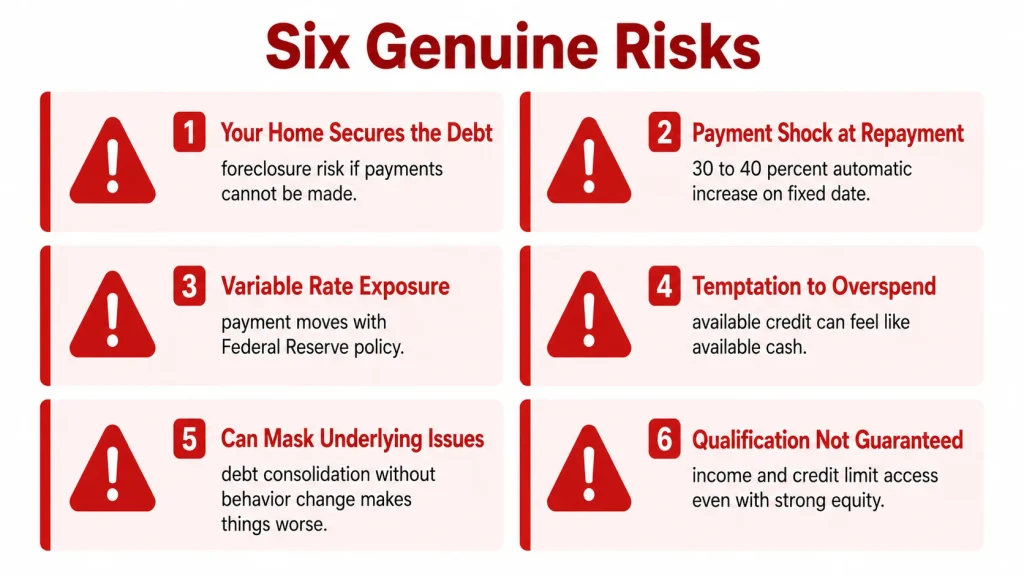
Your Home Secures the Debt
This is the foundational risk, and it deserves to be stated plainly rather than buried: if you cannot make payments, your lender can foreclose. A HELOC converts whatever you borrow into debt secured by your house — which is fundamentally different from unsecured debt like a credit card, where the worst case is credit damage rather than losing your home.
Payment Shock at the End of the Draw Period
The transition from interest-only payments to a fully amortized payment typically increases your monthly obligation by 30% to 40% — automatically, on a fixed date, regardless of whether your financial situation has changed. We cover this transition and how to prepare for it in detail in our article on HELOC Payment Shock. Borrowers who aren’t tracking their draw period end date are the ones most likely to be caught off guard.
Variable Rate Exposure
Your HELOC rate moves with the prime rate, which moves with Federal Reserve policy. This means your payment isn’t a number you can calculate once and rely on for the life of the loan — it’s a moving target that can increase meaningfully during periods of active rate hikes, as many borrowers experienced during 2022–2023.
The Temptation to Treat Available Credit as Available Cash
A large approved credit limit can create a psychological effect where the available credit feels like money you have, rather than debt you’d be taking on. This is a genuine behavioral risk, not just a financial one — borrowers who draw against a HELOC for non-essential spending, rather than for a specific planned purpose, frequently find themselves carrying a balance that doesn’t correspond to anything of lasting value.
It Can Mask Rather Than Solve Underlying Financial Issues
Using a HELOC to consolidate high-interest debt can be a smart move — but only if the behavior that created the debt has genuinely changed. Borrowers who consolidate credit card debt into a HELOC and then gradually rebuild the same credit card balances end up in a worse position than before: the original debt, now secured by their home, plus a new round of unsecured debt on top of it. We address this risk directly in our HELOC for Debt Consolidation guide.
Qualification Isn’t Guaranteed, Even With Equity
Having substantial home equity doesn’t automatically mean you’ll be approved for the credit limit you expect. Income, debt-to-income ratio, and credit score all factor into both approval and the actual limit offered — sometimes significantly reducing what your equity alone would theoretically support, as detailed in our HELOC credit limit breakdown.
A Side-by-Side Summary
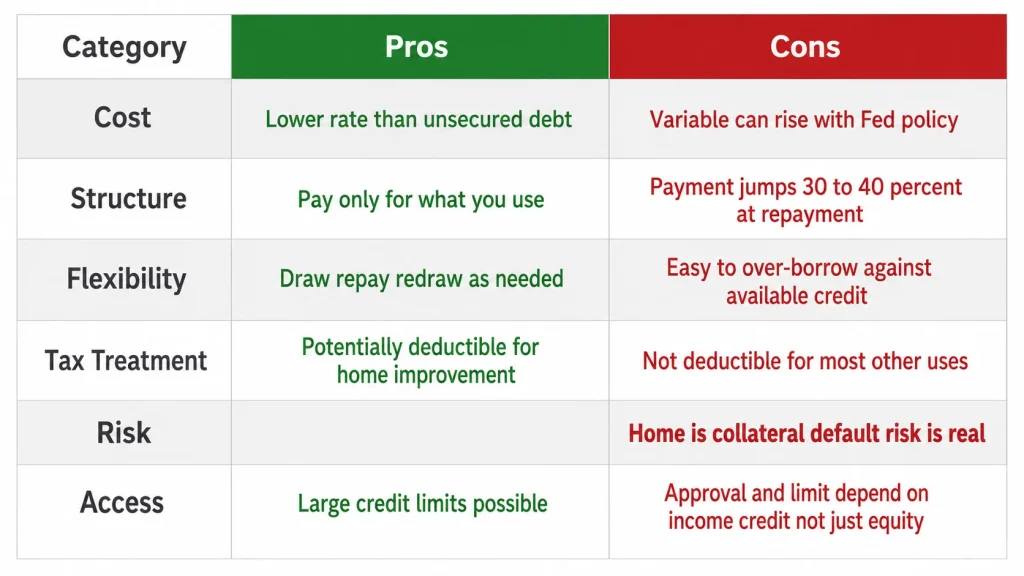
| Pros | Cons | |
|---|---|---|
| Cost | Lower rate than unsecured debt | Variable — can rise with Fed policy |
| Structure | Pay only for what you use | Payment jumps 30–40% at repayment |
| Flexibility | Draw, repay, redraw as needed | Easy to over-borrow against available credit |
| Tax treatment | Potentially deductible for home improvement | Not deductible for most other uses |
| Risk | — | Home is collateral; default risk is real |
| Access | Large credit limits possible | Approval and limit depend on income/credit, not just equity |
Who Genuinely Benefits From a HELOC
Homeowners with a specific, value-adding purpose for the funds. Home renovations that increase property value, debt consolidation paired with genuinely changed spending habits, or funding a clear investment opportunity with positive expected return — these are the use cases where a HELOC’s lower cost and flexibility translate into real financial benefit.
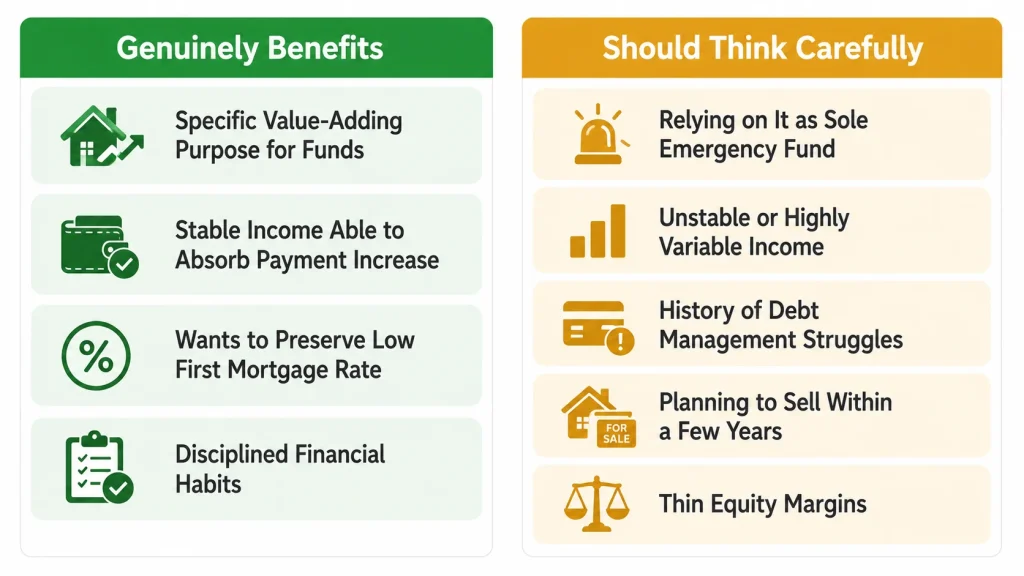
Homeowners with stable income and the ability to absorb a payment increase. If you’ve calculated your projected repayment-period payment and confirmed it fits comfortably in your budget — even accounting for some rate increase — the structural risks of a HELOC are manageable.
Homeowners who want to preserve a low first-mortgage rate. If refinancing your primary mortgage would mean giving up a rate well below current market levels, a HELOC lets you access equity without disturbing that mortgage — a meaningful advantage in the current rate environment, covered fully in our HELOC vs. Cash-Out Refinance comparison.
Homeowners with disciplined financial habits. The revolving nature of a HELOC rewards borrowers who draw intentionally and pay down proactively, and is far less forgiving for those who tend to use available credit as a spending cushion.
Who Should Think Carefully Before Getting a HELOC
Homeowners relying on it as a sole emergency fund. As detailed in our HELOC for Emergency Fund analysis, lenders can freeze or reduce HELOC credit lines during exactly the kind of economic stress that also tends to trigger emergencies — meaning the safety net you’re counting on may not be reliably available when you need it most.
Homeowners with unstable or highly variable income. Since the repayment-period payment is a fixed obligation regardless of income fluctuations, and since the underlying rate can rise independently of your circumstances, a HELOC adds a layer of financial rigidity that can be difficult to manage on irregular income.
Homeowners who have struggled with debt management in the past. If previous debt problems stemmed from a pattern of spending rather than a one-time event, converting that debt into a HELOC without addressing the underlying pattern often leads to a worse position, not a better one.
Homeowners planning to sell within a few years. The closing costs and the time needed to benefit from a HELOC’s lower rate don’t pencil out well for very short holding periods, particularly if an early termination fee would apply.
Homeowners with thin equity margins. If a modest decline in home value would push you uncomfortably close to your lender’s maximum CLTV, you’re more exposed to a credit line reduction or freeze than a homeowner with a substantial equity cushion.
A Practical Framework for Deciding
Rather than a generic yes-or-no, work through these four questions in order:
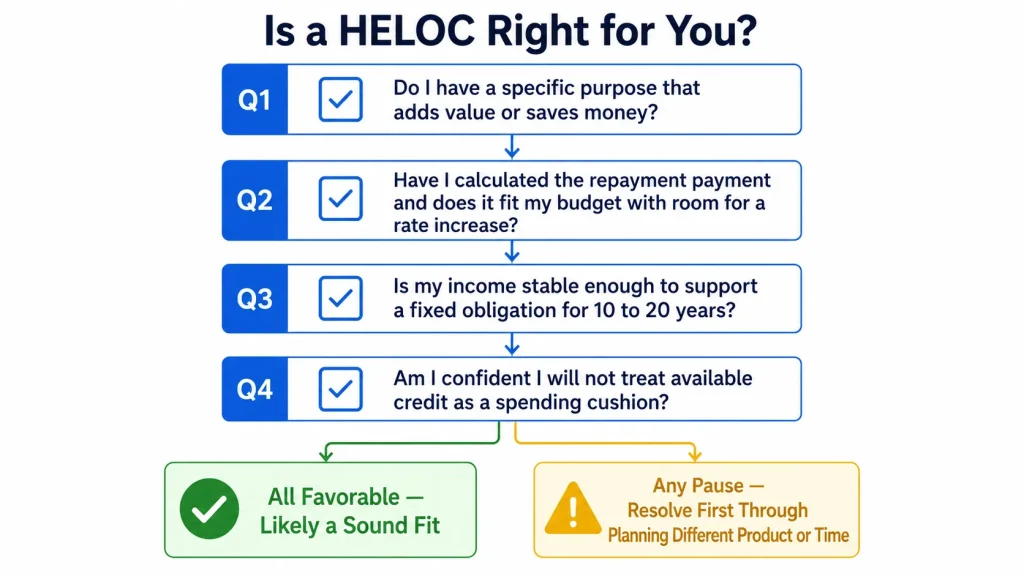
1. Do I have a specific purpose for the funds, and does that purpose add value or save money? A renovation that increases home value, debt consolidation paired with genuine behavioral change, or a clear investment opportunity — these justify the cost and risk. “I’d like access to more money in general” does not.
2. Have I calculated the repayment-period payment, and does it fit my budget with room for a rate increase? Use our HELOC Payment Calculator to model your specific numbers — both the draw-period minimum and the fully amortized repayment payment — before committing to anything.
3. Is my income stable enough to support a fixed payment obligation for 10–20 years? If your income is highly variable or uncertain, the structural rigidity of a HELOC’s eventual repayment obligation deserves extra scrutiny.
4. Am I confident I won’t treat the available credit as a spending cushion rather than a planned tool? This is the most honest and least quantifiable question, but often the most important one. A HELOC used exactly as planned is a genuinely efficient financial tool. A HELOC that gradually absorbs unplanned spending is a much riskier proposition than the interest rate alone suggests.
If your answers to all four lean favorable, a HELOC is likely a sound fit for your situation. If one or more gives you pause, that’s worth resolving — through more planning, a different product (see our HELOC vs. Home Equity Loan and HELOC vs. Personal Loan comparisons for alternatives), or simply more time — before opening the credit line.
The Bottom Line
A HELOC is genuinely one of the most cost-effective ways for a homeowner to access capital — when the purpose is clear, the numbers are calculated in advance, and the borrower’s habits match the discipline the product rewards. It’s also genuinely one of the riskier financial products available to consumers, precisely because the collateral is your home and the structure includes an automatic, significant payment increase built in from day one.
Neither the enthusiastic case nor the cautionary one is wrong. They’re both true, applied to different people in different circumstances. The work of deciding whether a HELOC is right for you isn’t about finding the universally correct answer — it’s about being honest with yourself about your specific purpose, your specific numbers, and your specific habits, and letting those details — not a generic recommendation — drive the decision.
Use our HELOC Payment Calculator to put real numbers behind your specific situation. Whatever you decide, deciding with the full picture in front of you is what actually matters.